
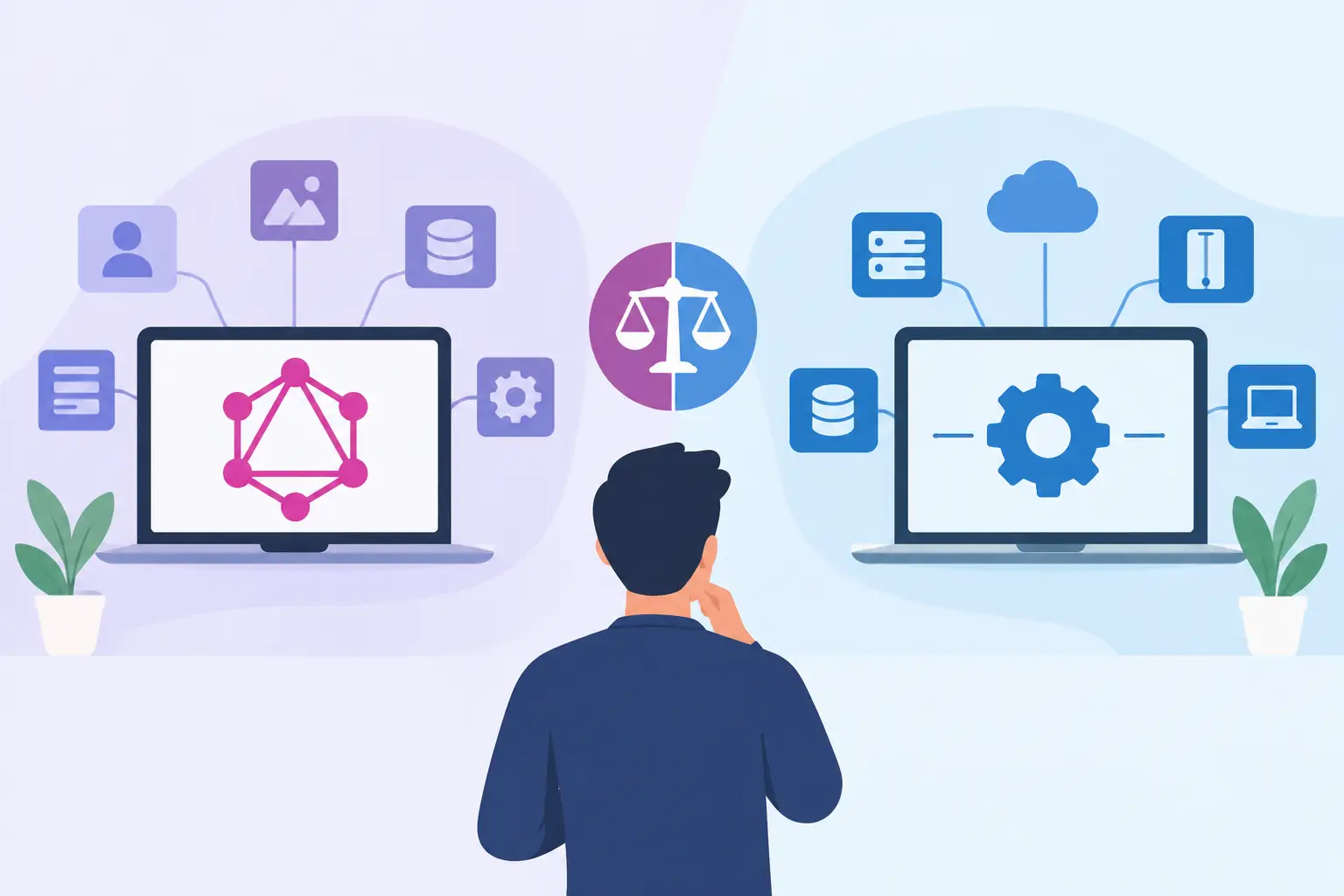
A mobile dashboard needs a customer profile, recent orders, support tickets, and reward points. With a conventional REST design, the app may make four requests to four endpoints. With GraphQL, it can request precisely those fields in one operation. That contrast explains why GraphQL vs REST APIs is still a meaningful architecture decision, not just a debate over syntax.
Neither approach automatically produces a faster, cleaner, or more scalable platform. REST remains the default for many public APIs and service integrations because it aligns naturally with HTTP. GraphQL can reduce client friction when products have varied data needs, but it introduces a schema, resolver layer, and new operational responsibilities. The right choice depends on consumers, data ownership, caching requirements, security controls, and the way your team evolves software.
How REST and GraphQL Model an API
REST organizes an API around resources. A customer might be available at `/customers/42`, while that customer’s orders could live at `/customers/42/orders`. Clients use HTTP methods such as GET, POST, PATCH, and DELETE to read or change those resources. HTTP status codes, cache headers, URLs, and standard tooling carry much of the API’s meaning.
GraphQL takes a different route. A server publishes a strongly typed schema that describes available objects, fields, queries, and mutations. Rather than choosing from a fixed set of response shapes, a client sends a query that specifies the fields it needs. The server resolves that query, potentially gathering information from databases, internal services, and external systems before returning one structured response.
This difference affects where flexibility lives. REST generally puts response design decisions on the server endpoint. GraphQL lets the client select from the capabilities exposed by the schema. That can be a major advantage for frontend teams, especially when web, mobile, and partner applications need different views of the same domain data.


GraphQL vs REST APIs: The Practical Differences
The most visible difference is data fetching. REST can create over-fetching when an endpoint returns fields a client does not need, and under-fetching when a screen requires several endpoints. Well-designed REST APIs can reduce both problems with endpoint design, filtering, sparse fieldsets, and purpose-built aggregation endpoints. Still, the client often needs to work within response shapes chosen in advance.
GraphQL gives clients more control. A product page can ask for a product name, price, stock status, and three review excerpts without receiving an entire product record. This is particularly useful on constrained mobile networks or in frontend systems where requirements change quickly. It also prevents teams from creating a growing collection of narrowly tailored REST endpoints for every page and workflow.
That flexibility has a cost. A GraphQL query may look like one request, but its resolvers can trigger many database queries or downstream calls. The classic N+1 issue occurs when fetching a list of parent records causes a separate lookup for every child record. Data loaders, batching, query planning, and resolver instrumentation are essential, not optional polish.
REST’s behavior is often easier to reason about at the network layer. A GET request to a stable URL works naturally with browser caches, CDNs, gateways, observability tools, and HTTP semantics. GraphQL commonly uses a single endpoint, frequently over POST, which makes generic HTTP caching less straightforward. Teams can use persisted queries, application-level caches, normalized client caches, and CDN-aware GET requests, but they must deliberately design for them.
| Area | REST | GraphQL | | — | — | — | | Data shape | Defined by each endpoint | Selected by the client from a schema | | HTTP caching | Usually direct and mature | Requires more intentional query caching | | Versioning | Often uses URL or header versions | Usually evolves through additive schema changes | | Error handling | HTTP status codes map clearly to failures | May return partial data plus field-level errors | | Best fit | Resource-oriented services and broad integrations | Complex client experiences with varying data needs |
Versioning and Evolution Are Different Problems
REST teams often version an API when a breaking response change is unavoidable. `/v1` and `/v2` endpoints are familiar, explicit, and easy for external consumers to understand. The downside is maintenance: old versions can remain in production long after newer contracts exist.
GraphQL is designed around additive evolution. Teams add a field, type, or query without affecting clients that do not use it. When a field needs replacement, they deprecate it in the schema, document the preferred alternative, and monitor usage before removal. This can make API evolution feel less disruptive.
But GraphQL does not eliminate breaking changes. Renaming a type, changing field behavior, tightening authorization, or modifying pagination semantics can still break consumers. Schema governance matters in either model. Treat contracts as products, review changes, publish examples, and track how real clients use the API before removing capabilities.
Security Requires Different Guardrails
REST security tends to be endpoint-focused. Teams authenticate requests, authorize actions against resources, validate inputs, apply rate limits, and restrict sensitive fields in server responses. This model maps well to gateway policies and established security reviews.
GraphQL needs those controls plus field-level thinking. A user may be allowed to read a customer record but not the customer’s billing address or internal risk score. Authorization should run where data is resolved, rather than relying only on a check at the top of the request. Otherwise, a carefully crafted query can expose data paths that were not considered during UI development.
Query complexity is another GraphQL-specific concern. Deep nesting, broad connections, aliases, and expensive fields can place unexpected load on services and databases. Set depth limits and complexity budgets, cap pagination sizes, enforce timeouts, and rate-limit by identity. Persisted queries are valuable for public clients because the server can accept an approved query identifier instead of arbitrary query text.
REST is not inherently safer. An API with inconsistent authorization, overly broad endpoints, or weak input validation remains vulnerable. The useful distinction is operational: GraphQL concentrates a large amount of access capability behind a schema, so its schema and resolvers require disciplined protection.
When REST Is the Better Choice
REST is often the practical answer for resource-focused services, file uploads, webhook receivers, and APIs consumed by many external partners. Its conventions are widely understood, its documentation model is familiar, and common infrastructure already knows how to route, cache, inspect, and protect HTTP endpoints.
It also fits well when the service boundary is clear. A shipping service that creates labels, tracks parcels, and returns carrier events may not gain much from a graph-shaped query layer. Clear REST endpoints can be easier for partners to test and easier for operations teams to monitor.
Choose REST when predictable HTTP behavior and simple integration are more valuable than client-controlled response shapes. It is also a sensible starting point for smaller teams that do not yet have a proven need for GraphQL’s added architecture.
When GraphQL Earns Its Complexity
GraphQL is strongest when multiple clients need to compose related data in different ways. Think of a commerce platform serving a storefront, internal operations console, native app, and customer support workspace. Each interface needs overlapping domain data, but not the same fields or relationships.
It can also provide a useful aggregation layer over fragmented backends. Instead of forcing a frontend to understand separate inventory, catalog, identity, and pricing services, a GraphQL gateway can present a coherent schema. That can improve developer experience, but only if schema ownership is clear and resolver performance is continuously measured.
For organizations moving toward federated services, GraphQL federation can let domain teams contribute parts of one graph. This is powerful, yet it can hide distributed-system complexity behind a tidy query. Establish ownership boundaries, define service-level objectives, and make downstream failures visible in telemetry.
A Sensible Adoption Path
You do not need an all-or-nothing migration. Many mature systems use REST for command-oriented operations and external integrations while adding GraphQL as a backend-for-frontend layer. The GraphQL layer can consume existing REST endpoints first, then move to more direct service or data access where performance and ownership justify it.
Start with a real client pain point, such as a page that requires too many calls or a mobile app repeatedly blocked by endpoint changes. Define a small schema around that workflow, instrument resolver timing, enforce query limits from day one, and compare the result against the REST experience. A pilot should validate operational behavior, not merely prove that queries look cleaner.
The better API style is the one that makes your consumers productive without making your platform harder to secure, observe, and change. Build from the shape of your product and organization, then let measured usage – not architecture fashion – guide the next decision.