A pull request can look harmless and still become a production incident. A compromised dependency, a leaked token in a build log, or an overly privileged runner can turn normal automation into a delivery path for attackers. To create a secure CI pipeline, teams need to treat continuous integration as a trust boundary, not merely a faster way to run tests.
CI security is not about adding one scanner at the end of a workflow. It is about deciding what code can run, what identity it runs as, which data it can access, and what evidence exists before an artifact moves forward. Done well, these controls make releases more dependable without burying developers in noisy failures.
Start With the CI Threat Model
A CI system processes some of the most sensitive materials in engineering: source code, credentials, package registry tokens, cloud access, build artifacts, and deployment metadata. It also runs code that may come from contributors, forks, automated dependency updates, or third-party actions.
Map the pipeline before selecting controls. Identify the repositories that trigger builds, the event types that trigger privileged jobs, the runners that execute them, the secrets available to each job, and the destinations that receive artifacts. This exercise often exposes risky defaults, such as a pull request workflow that can access deployment credentials or a shared runner that retains files from an earlier job.
The level of protection should reflect the repository and release model. An internal service with a small team may accept a simpler setup than a public SDK that accepts external contributions. The key is to make the trade-off explicit. Convenience should never silently grant untrusted code access to production authority.
Create a Secure CI Pipeline Around Least Privilege
Least privilege is the organizing principle for CI identities. A test job usually needs to read source code and retrieve public dependencies. It does not need permission to publish a package, modify a release, or deploy cloud infrastructure.
Use separate identities for testing, publishing, and deployment. Scope each token to its exact repository, environment, registry, or cloud resource. Prefer short-lived credentials issued through workload identity or an identity provider over long-lived keys stored in a CI platform. Short-lived tokens reduce the useful lifetime of a stolen credential and make rotation less disruptive.
Environment boundaries matter as much as token scopes. Production credentials should only be available to jobs that run from protected branches or approved release tags, ideally after an environment approval where the risk warrants it. A staging deployment may be fully automated, while a production deployment may require a reviewer and a recorded change request. Neither model is universally correct; the appropriate choice depends on release frequency, blast radius, and regulatory requirements.
Treat pull requests from forks as untrusted by default. Do not expose secrets to their workflows, and do not run their code in a privileged context just to enable a convenient integration test. If a maintainer needs to run a privileged validation job, use an explicit, reviewed event that checks out a known commit and limits available credentials.
Protect Secrets Before They Reach a Log
Secret managers and CI-provided encrypted variables are useful, but they are only the beginning. A secret can still be exposed when a script prints its environment, a command runs with debug tracing enabled, or a build tool writes configuration files into an uploaded artifact.
Pass secrets only to the job and step that need them. Avoid placing credentials in global environment variables. Mask values in logs, but do not depend on masking as a security control: altered, encoded, or partial values may evade redaction. Configure tools to use temporary credential files where possible, then remove those files before artifacts are collected.
Add secret detection at two points. Pre-commit hooks and local scanners help developers catch mistakes early. Server-side scanning in CI provides the enforcement layer and covers code that bypasses local tooling. When a secret is found, revoke it first, then investigate history and exposure. Removing it from the current commit does not make the credential safe.
Secure Dependencies and Build Actions
A clean application repository can still produce a compromised build if it pulls malicious or altered third-party code. Dependencies, base images, reusable pipeline components, and CI actions all belong in the supply chain.
Pin external actions and reusable workflow components to immutable commit hashes rather than moving tags. Tags such as `v3` are easier to read, but their underlying code can change. A commit hash provides a fixed review target. For container images, pin a digest when reproducibility and supply-chain assurance are priorities.
Use lockfiles and enforce deterministic dependency installation in CI. This prevents a build from quietly selecting newer package versions than developers tested locally. Pair that practice with software composition analysis that checks for known vulnerabilities, license concerns, and deprecated packages. Findings should be triaged by reachability and severity instead of blindly blocking every build. A critical vulnerability in a production runtime path deserves a different response than a low-risk issue in a development-only tool.
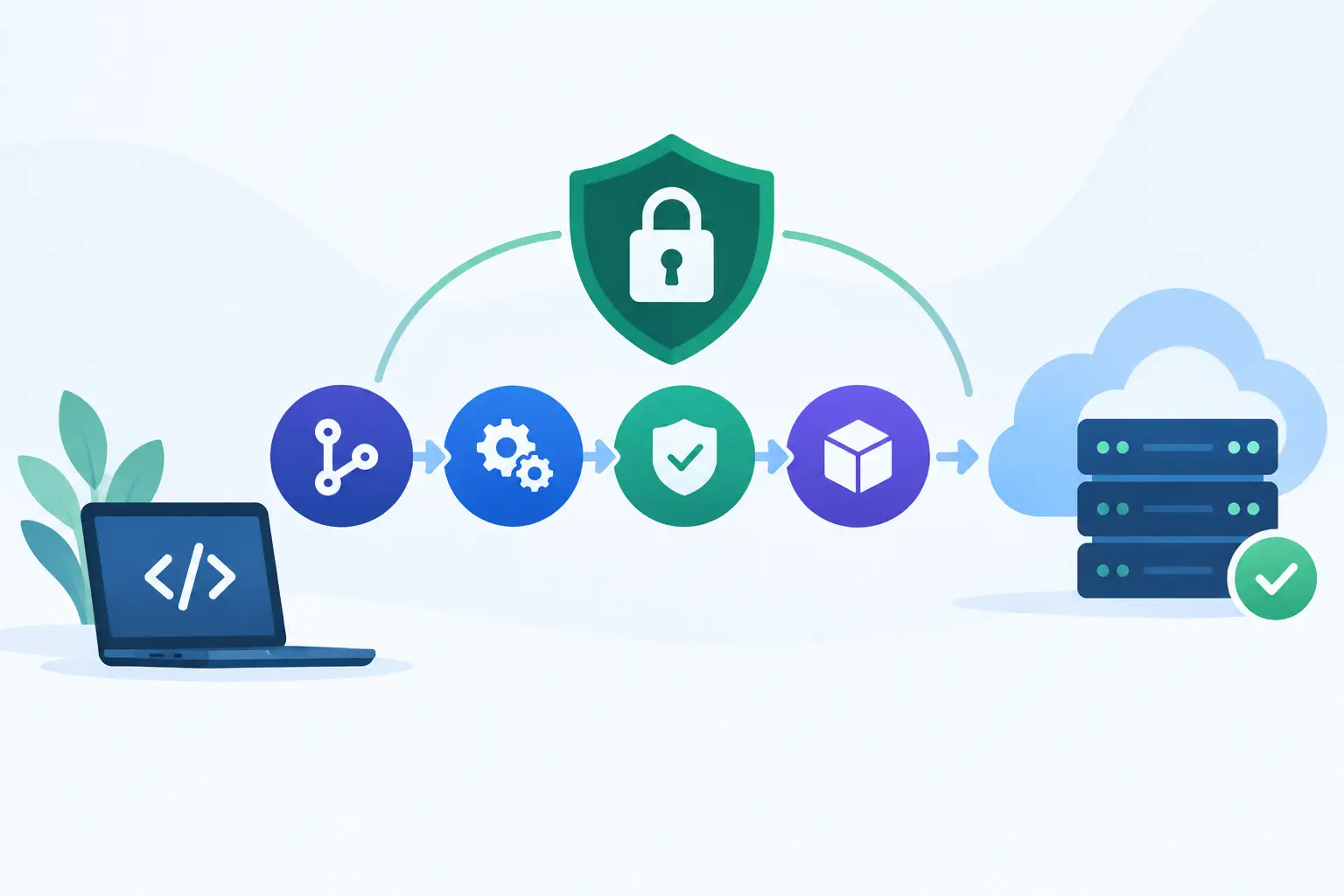
Build artifacts should be traceable to a source revision, a dependency set, and a specific pipeline run. Generate a software bill of materials when your ecosystem and release process support it. Artifact signing and provenance attestations add a further layer: downstream systems can verify where an artifact came from before promoting or deploying it.
Harden the Runners That Execute Code
Runners are execution environments, and they deserve the same attention as application servers. Hosted ephemeral runners reduce maintenance and minimize persistence between jobs, which is a strong default for many teams. Self-hosted runners can be necessary for private network access, specialized hardware, or performance, but they introduce more operational responsibility.
For self-hosted runners, isolate workloads by repository or trust level when possible. Use ephemeral instances that are destroyed after a job, restrict outbound network access, patch the runner image regularly, and prevent untrusted jobs from accessing host sockets or privileged containers. A Docker socket mounted into a build container can effectively grant control of the host, so use it only when the design truly requires it.
Also control what runners can reach. Most test jobs do not need access to production databases, internal admin APIs, or broad cloud networks. Network segmentation limits damage if a dependency or build script is compromised.
Make Security Checks Useful to Developers
Security controls fail when developers learn that every alert is a false positive or every small fix requires an exception process. Place fast, high-signal checks early: formatting, unit tests, secret scanning, and basic static analysis fit well in pull request validation. Longer integration tests, deeper scans, and release attestations can run later or in parallel.
A practical pipeline often evaluates four categories before release:
- source and configuration issues, including insecure defaults and leaked credentials
- third-party dependency and container image risk
- test and policy results that determine whether the change is releasable
- artifact integrity, provenance, and approval requirements for promotion
Define clear ownership for each failure type. Developers can usually fix a vulnerable direct dependency or insecure code pattern. Platform and security teams may need to maintain scanner rules, patch runner images, or approve an exception. Time-bound exceptions with documented compensating controls are safer than permanent suppressions that nobody revisits.
Protect the Path From CI to Production
CI may build and validate software, but security can be lost during promotion. Use immutable artifacts: build once, then promote the same signed artifact through test, staging, and production. Rebuilding for each environment makes it harder to prove that production received what passed validation.
Restrict release creation and deployment configuration changes. An attacker who cannot alter application code may still succeed by modifying a pipeline file, changing an artifact source, or weakening an approval rule. Require review for CI configuration changes, protect default branches, and audit changes to secrets, runner settings, and environment policies.
Keep pipeline logs, artifact metadata, approvals, and security results long enough to support incident response. The goal is not surveillance for its own sake. It is the ability to answer concrete questions quickly: What ran? Which identity approved it? What artifact was deployed? Which inputs were used?
Measure the Security of the Delivery System
A secure pipeline is maintained, not declared finished. Track the percentage of repositories using short-lived credentials, pinned CI components, protected environments, ephemeral runners, and signed artifacts. Review failed security checks for recurring patterns, and measure how long critical findings remain open.
The most effective next step is usually small and visible: remove production secrets from pull request jobs, pin a widely used external action, or make release artifacts immutable. Each improvement narrows a real attack path while giving the team a clearer, more trustworthy route from commit to production.