
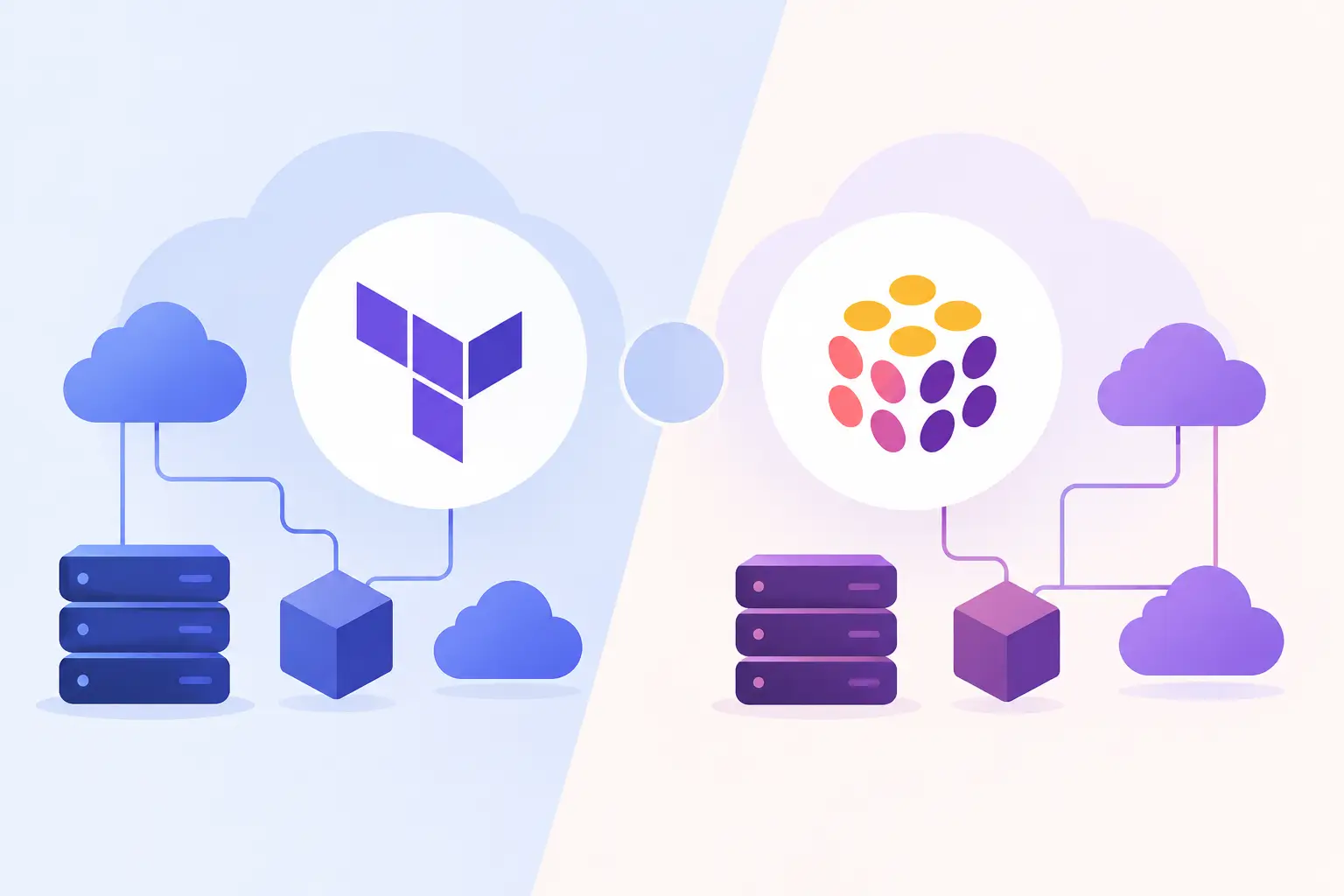
A new AWS account, a Kubernetes cluster, and a few managed databases can look simple in a diagram. Then permissions, network rules, DNS records, secrets, tagging, and deployment environments arrive. The Terraform vs Pulumi infrastructure decision matters because infrastructure as code is not just about provisioning resources. It becomes part of how your team reviews change, tests risk, manages cloud state, and recovers from mistakes.
Terraform and Pulumi solve the same foundational problem: define infrastructure in source control and apply repeatable changes through automation. Their biggest difference is the authoring experience. Terraform uses HashiCorp Configuration Language (HCL), a declarative language built specifically for infrastructure. Pulumi lets teams define infrastructure with general-purpose languages such as TypeScript, Python, Go, C#, Java, and YAML.
Neither choice automatically produces better cloud architecture. The better fit depends on who owns the platform, how much abstraction your team needs, and whether consistent infrastructure patterns matter more than using a familiar programming language.
Terraform vs Pulumi Infrastructure at a Glance
Terraform is intentionally declarative. You describe the desired end state, such as a virtual network with subnets, a container service, and an identity policy. Terraform builds a dependency graph and determines the actions needed to reach that state. HCL has expressions, modules, variables, loops, and conditionals, but it remains focused on describing resources rather than writing arbitrary application logic.
Pulumi also uses a desired-state model, but its programs are written in a conventional language. A TypeScript project can use functions, classes, package managers, unit test frameworks, and language-native control flow to generate infrastructure definitions. Pulumi tracks resource dependencies during execution and produces a plan before applying changes.

This difference changes daily engineering work. Terraform tends to make infrastructure code visually consistent across teams, even when its authors use different application stacks. Pulumi can feel more natural to software developers because patterns from application development transfer directly into infrastructure projects.
Terraform’s strengths
Terraform has a large provider ecosystem and a mature module culture. Its HCL files are easy for cloud engineers, security teams, and reviewers to scan because resource declarations follow a predictable structure. For organizations managing multiple clouds or a wide mix of SaaS platforms, provider breadth is often a practical reason to start with Terraform.
The language also creates useful constraints. When a team cannot casually add complex loops, network calls, or hidden runtime behavior to an infrastructure definition, plans are often easier to reason about. That is valuable for shared platform repositories where many engineers contribute occasionally.
Terraform’s workflow is familiar across the industry: initialize providers, generate a plan, review it, and apply approved changes. It works well when teams want a clear boundary between infrastructure configuration and application code.
Pulumi’s strengths
Pulumi is compelling when infrastructure needs to behave like a reusable software library. A platform team can create typed components that package an approved network pattern, service deployment, observability configuration, and default security controls. Application teams can then consume that component with a small set of well-defined inputs.
General-purpose languages also make complex generation logic more comfortable. For example, a team producing similar environments for dozens of tenants may prefer Python or TypeScript over HCL when it needs data transformations, custom validation, or integration with existing internal libraries.
Pulumi supports familiar testing practices. Teams can unit test component behavior, validate generated resources, and use language tooling already present in their development workflow. This does not replace integration testing against a cloud account, but it can catch errors earlier than a plan-only review.
The Trade-Off: Flexibility Versus Guardrails
The key Terraform vs Pulumi infrastructure trade-off is not declarative versus imperative in a simplistic sense. Both tools let teams describe desired infrastructure. The more useful question is how much programming flexibility your infrastructure code should have.
Terraform’s narrower language reduces cognitive overhead. An engineer opening an unfamiliar repository can usually identify providers, resources, variables, outputs, and modules quickly. Its limitations can become frustrating when requirements demand sophisticated data processing or abstractions that feel awkward in HCL.
Pulumi removes many of those limitations, but it introduces application-code complexity. A Pulumi project can inherit dependency version conflicts, over-engineered class hierarchies, asynchronous behavior, and abstractions that obscure the resulting cloud resources. A TypeScript infrastructure repository is not automatically easier to maintain just because the engineering organization uses TypeScript elsewhere.
For most teams, the decision comes down to governance. If your platform group needs a highly standardized model that many teams can read and safely modify, Terraform’s constraints are an advantage. If a platform engineering team can own well-tested internal components and wants developers to consume infrastructure through code, Pulumi may offer a stronger developer experience.
State Management and Deployment Operations
Both products use state to map declared resources to real infrastructure. State is operationally significant: it contains resource identifiers and may contain sensitive values. It needs controlled access, encryption, backup practices, and protections against concurrent modifications.
Terraform can store state in remote backends, including cloud object storage paired with a locking mechanism, or in managed offerings. The backend choice affects access control and team workflow, so it should be designed before a repository becomes widely used. Local state is appropriate for experimentation, not shared production infrastructure.
Pulumi stores state in its managed service by default, while self-managed backend options are also available. Its service-oriented experience can simplify collaboration, history, and policy management for teams that prefer a managed control plane. Organizations with strict data residency, private networking, or internal-control requirements should validate backend and secrets-management options early rather than treating them as a later migration detail.
A practical point often gets missed: state architecture matters more than the tool’s syntax once an estate grows. Split stacks by environment and ownership boundaries. Avoid one massive state file that includes every production resource. Establish a process for importing existing infrastructure and for handling resources that must be retained when code changes.
Providers, Components, and Reuse
Terraform modules are the standard mechanism for reuse. A well-designed module exposes only the inputs consumers should control and encodes safe defaults for the rest. For example, an internal Kubernetes module might standardize logging, encryption, node security, and tagging while allowing teams to select a supported size profile.
Pulumi packages reusable patterns as components in a language ecosystem. That can provide strong typing and richer developer ergonomics. A component can expose methods, interfaces, and validation that feel natural to application engineers. It can also be harder to inspect if the implementation is buried behind several layers of code.
In either tool, reuse succeeds when the abstraction is small and opinionated. Do not create a universal module or component intended to represent every possible load balancer, database, or cluster. Those abstractions usually become a maze of optional settings. Start with a proven organizational pattern, document its boundaries, and add variants only when real users need them.
Security, Policy, and Review Workflows
Infrastructure as code shifts security earlier, but only if review and automation are designed around it. Both Terraform and Pulumi can support policy-as-code approaches that evaluate planned resources before deployment. Use this capability to enforce controls such as approved regions, encryption, required tags, private networking, and restrictions on publicly exposed services.
Terraform benefits from broad support across CI systems, scanners, and policy tools. Pulumi fits especially well where teams want policy checks and custom validation written in their primary language. The best option is the one your delivery pipeline can enforce consistently.
Do not rely on a plan output as the only approval artifact. Reviewers need context: why a database replacement is expected, whether an identity permission is broader than necessary, and what rollback looks like if an apply fails. Require pull requests, protect deployment branches, restrict production credentials, and scan repositories for exposed secrets. These practices carry more weight than the Terraform-or-Pulumi choice.
How to Choose for Your Team
Choose Terraform when you want a purpose-built configuration language, mature multi-provider coverage, predictable repository conventions, and a broad hiring pool. It is a strong default for central infrastructure teams and organizations that expect many engineers to review or contribute to shared cloud foundations.
Choose Pulumi when your developers are prepared to treat infrastructure as a software product. It is particularly effective for teams that need typed internal platforms, want language-native tests, or need nontrivial abstractions that would be cumbersome in HCL.
There are valid hybrid cases as well. A company may use Terraform for account baselines, networking, identity, and shared cloud services, then use Pulumi for application-facing infrastructure components. This adds toolchain overhead, so it should be an intentional boundary rather than a response to individual preference.
Before standardizing, run a small production-oriented evaluation. Build the same representative service in each tool: network access, identity roles, secrets, a compute workload, monitoring, and a managed data service. Measure not only authoring speed, but also plan readability, test quality, onboarding time, policy enforcement, state operations, and incident recovery.
The right tool is the one your team can operate with discipline six months after the first successful deployment. Pick the model that makes safe changes easier to understand, review, and repeat when production is under pressure.