A customer completes checkout, inventory drops below a threshold, a shipment is created, and analytics needs the new revenue figure. In a tightly coupled application, one request may try to perform every follow-up action before returning a response. That design works until one dependency slows down, a new downstream system appears, or traffic spikes at the wrong moment. This event driven architecture guide shows how teams can separate those responsibilities without trading simplicity for uncontrolled complexity.
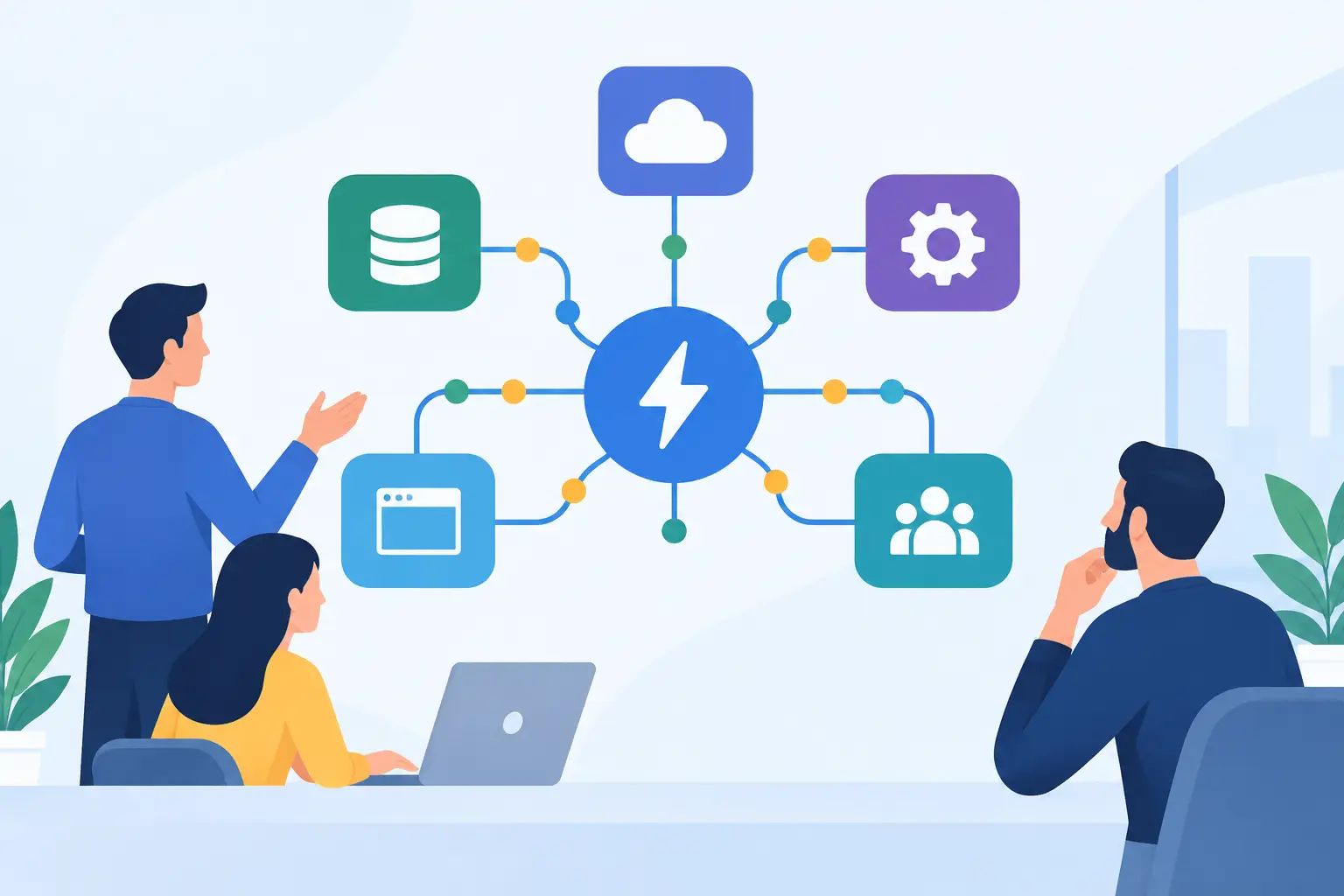
Event-driven architecture, often abbreviated as EDA, is a style in which services publish facts about something that happened and other services react to those facts asynchronously. Rather than calling every dependent system directly, the checkout service can publish an `OrderPlaced` event. Inventory, fulfillment, notifications, fraud detection, and reporting can each consume it according to their own needs.
The result is not magic scalability. It is a different set of engineering choices. Used well, EDA reduces coupling, absorbs bursts of work, and lets teams add capabilities without repeatedly changing the original service. Used carelessly, it can create unclear ownership, duplicate processing, and production failures that are difficult to trace.
What Event-Driven Architecture Changes
A synchronous request-response flow creates a direct dependency between the caller and the system it needs. If Service A calls Service B, Service A must know where B is, how to authenticate, what response to expect, and what to do when B is unavailable. This is appropriate when the caller needs an immediate answer, such as validating credentials or calculating a price shown to a user.
An event is different. It records a business or technical fact that has already occurred: `UserRegistered`, `PaymentCaptured`, `FileUploaded`, or `DeploymentCompleted`. Producers publish events without needing to know which consumers exist. Consumers subscribe and process events later, usually through an event broker such as Apache Kafka, Amazon EventBridge, Azure Service Bus, RabbitMQ, or Google Pub/Sub.
That separation changes how a system evolves. A product team can add a loyalty-points consumer to `OrderCompleted` without modifying the order service. An operations team can subscribe to security-related events for monitoring. A data platform can build a warehouse pipeline from the same event stream. The producer remains focused on accurately reporting what happened.
The Core Building Blocks
An event-driven system has more moving parts than a direct API integration, but their roles should stay clear. The producer owns the action and publishes the resulting event. The broker accepts, stores, and routes that event. Consumers independently process it. A schema defines the event contract, including field names, types, version information, and meaning.
The broker is not merely plumbing. Its capabilities affect system behavior. Kafka is commonly used for high-volume, durable event streams and replayable history. Message queues are often a strong fit for work distribution, where one worker should handle one job. Cloud event buses can reduce infrastructure management and integrate naturally with managed services. The right choice depends on throughput, ordering requirements, retention, operational skills, and cloud strategy.
Events should describe facts, not commands disguised as facts. `InvoiceGenerated` says an invoice exists. `GenerateInvoice` tells another system what to do. Commands can have a place, especially in workflow orchestration, but confusing the two creates hidden coupling. A fact can support many consumers; a command usually assumes a specific receiver and outcome.
A Practical Event Flow
Consider an order service. After it commits a new order, it publishes an `OrderPlaced` event containing an event ID, order ID, customer ID, timestamp, currency, total, and a list of purchased items. Inventory reserves stock, fulfillment begins packing, and the notification service sends confirmation.
Each consumer tracks its own processing state. If notification delivery fails, the order does not need to be created again. The notification consumer can retry, move the failed message to a dead-letter queue after repeated errors, and alert the support team. This isolation is one of EDA’s strongest operational benefits.
Event Driven Architecture Guide: Design for Failure First
The hard part of EDA is not publishing the first message. It is defining what happens when messages arrive twice, arrive late, arrive out of order, or cannot be processed at all.
Most distributed brokers provide at-least-once delivery. A consumer may receive a message more than once, particularly after a timeout or crash. Build consumers to be idempotent: processing the same event twice should produce the same business result as processing it once. A payment consumer, for example, should persist processed event IDs or use a unique transaction key before attempting a charge.
Ordering is also narrower than many teams assume. A broker may preserve order within a partition, topic key, or queue, but not across the entire system. If an `OrderCanceled` event reaches a consumer before `OrderPlaced`, the consumer needs a defined response. It may defer the cancellation, retrieve current state from an authoritative service, or model state transitions that tolerate temporary disorder. Do not rely on global ordering unless the platform and design explicitly guarantee it.
Retries need boundaries. Transient failures such as a brief network timeout deserve automatic retry with exponential backoff. Invalid payloads, broken schema assumptions, and missing reference data generally do not improve with repeated attempts. Route those events to a dead-letter queue or failure topic with enough context for investigation. A dead-letter queue without ownership or an alerting process is simply a hidden backlog.
Use the Transactional Outbox Pattern
A common failure occurs when a service writes data to its database and then publishes an event. If the database transaction succeeds but publishing fails, downstream systems never learn about the change. If publishing succeeds but the transaction rolls back, consumers receive an event for something that does not exist.
The transactional outbox pattern addresses this gap. In the same database transaction that writes the business record, the service writes an outbox row describing the event. A separate relay process reads committed outbox records and publishes them to the broker. This does not eliminate duplicate delivery, so consumers still need idempotency, but it closes a major consistency hole.
Treat Event Schemas as Public Products
An event contract is an API contract, even when no external customer sees it. Changing `customerName` to `name`, removing a field, or redefining a status value can break consumers just as surely as an incompatible REST API change.
Start with a stable envelope: event ID, event type, occurred-at timestamp, producer name, schema version, and correlation ID. The payload should include only the information consumers need to react. Avoid copying an entire database row into every event by default. Large, unstable payloads raise privacy risks and make evolution harder.
Favor additive changes. Adding an optional field is usually safer than renaming or deleting an existing field. When a breaking change is unavoidable, publish a new event version and run both versions during a deliberate migration period. A schema registry and compatibility checks in CI can prevent accidental contract breaks before deployment.
Ownership matters as much as format. The team that owns the business capability should own the event’s meaning and documentation. Consumers can request additions, but they should not silently depend on internal producer fields. This discipline prevents event streams from becoming undocumented shared databases.
Build Observability Into Every Message
Asynchronous systems can feel invisible when tracing is incomplete. A user reports that an order confirmation never arrived, but the order service shows success. Without correlated telemetry, engineers may need to search logs across several services and brokers with no reliable connection between them.
Include a correlation ID and causation ID in events. The correlation ID follows a business flow, such as one checkout journey. The causation ID identifies the event or command that triggered the current event. Propagate both through producers and consumers, then connect them to structured logs, distributed traces, and metrics.
Monitor consumer lag, processing latency, retry counts, dead-letter volume, broker storage, and handler error rates. Lag alone is not always a problem. A reporting pipeline may reasonably process data minutes later, while fraud screening may have a seconds-level requirement. Define service-level objectives by workflow, not by a generic dashboard threshold.
Security and Data Governance Cannot Be Afterthoughts
Events often travel farther and live longer than synchronous API responses. That makes data minimization essential. Do not put passwords, payment card data, access tokens, or unnecessary personal data into event payloads. If a consumer needs sensitive information, consider sending a reference and retrieving the data through an authorized path.
Apply authentication and authorization at the broker level. A service should publish only to approved topics and consume only the events it requires. Encrypt data in transit and at rest, set retention rules deliberately, and audit access to sensitive streams. For regulated data, understand whether replay, replication, and dead-letter handling create additional compliance obligations.
When Event-Driven Architecture Is the Wrong Choice
EDA is not a replacement for every API call. A web application still needs synchronous interactions for immediate user feedback. Some simple internal workflows are clearer as direct calls, especially when there are only two services and no expected expansion. Introducing a broker, schema governance, replay tooling, and asynchronous debugging can be unnecessary overhead.
It is also a poor fit when a workflow demands strict, immediate consistency across multiple systems and the business cannot tolerate temporary divergence. In those cases, a carefully scoped synchronous transaction or a workflow with explicit compensation may be easier to reason about.
The strongest architectures are usually hybrid. They use APIs for queries and immediate decisions, then publish events for downstream reactions, integration, analytics, and longer-running work.
Start with one business event that already has multiple downstream effects, define its owner and contract, and make one consumer idempotent before scaling the pattern. That small implementation will reveal the operational habits your team needs long before event-driven architecture becomes the foundation beneath every critical workflow.