
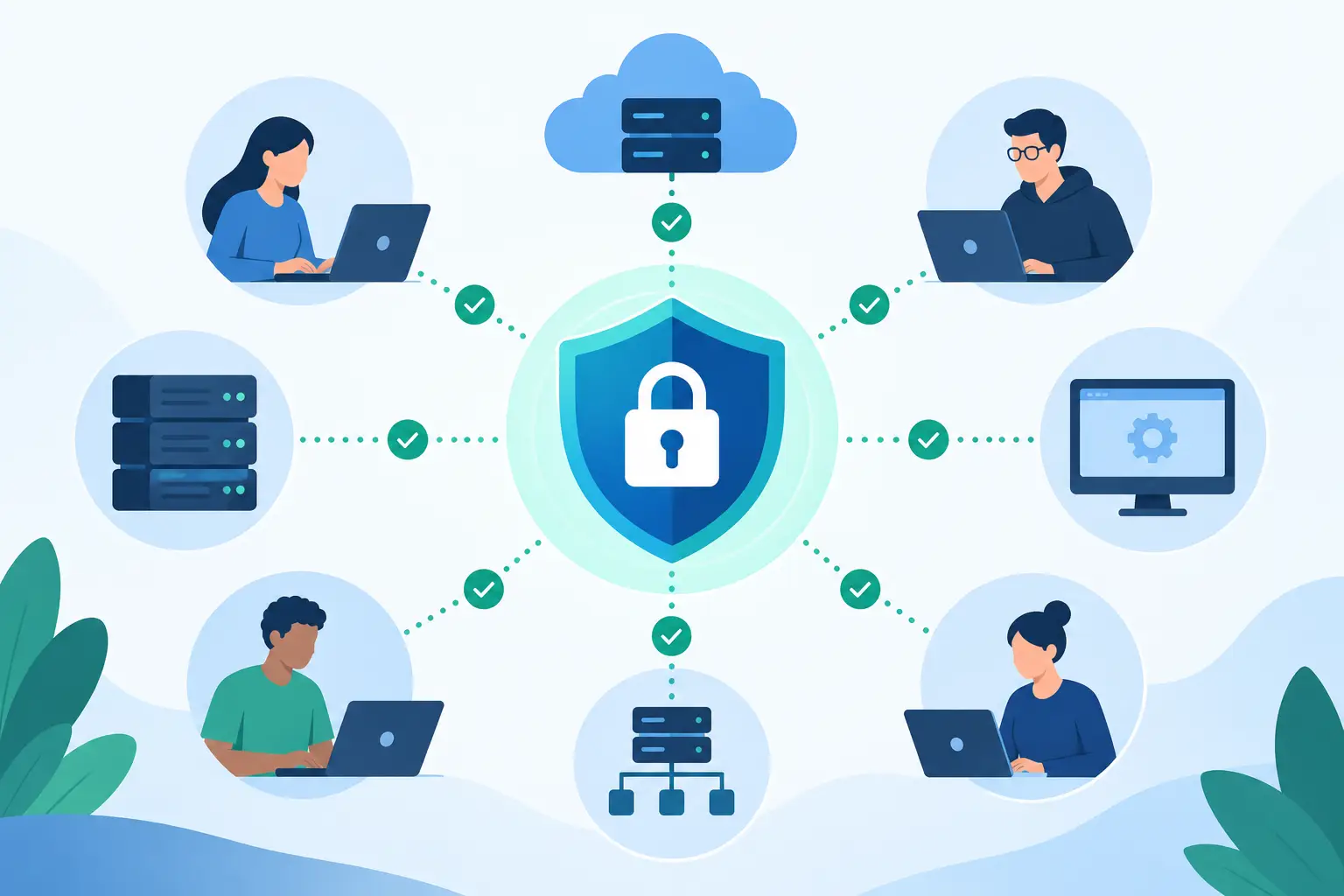
A developer signs in from a managed laptop, opens a source repository, deploys to a cloud environment, and calls internal APIs. In a traditional network, much of that journey may be trusted because the user is on the VPN. A zero trust networking guide starts from a different premise: every request must earn access based on verified identity, device posture, policy, and current risk.
That shift matters because software teams no longer operate inside one defensible corporate perimeter. Applications run across cloud accounts, SaaS platforms, Kubernetes clusters, branch offices, and employee home networks. Credentials can be stolen, devices can be unmanaged, and a compromised workload can move laterally faster than a security team can react. Zero trust narrows the blast radius by making access specific, continuously evaluated, and difficult to reuse outside its intended context.
What Zero Trust Networking Actually Changes
Zero trust is often reduced to the slogan “never trust, always verify.” It is useful shorthand, but implementation requires more precision. Zero trust networking is an architecture and operating model that replaces broad network-based trust with explicit, policy-driven access to applications, services, data, and infrastructure.
The core change is simple: being connected to a network does not automatically grant access to resources on that network. A user who reaches a private application still needs authorization for that application. A service running in one Kubernetes namespace still needs an approved identity and path to call a service in another namespace. An administrator connecting from a compliant device may receive time-limited access, while the same request from an unmanaged endpoint is blocked or challenged.
This is not a single product category. Identity providers, endpoint management platforms, firewalls, secure web gateways, service meshes, API gateways, cloud IAM, and observability tools can all contribute. The goal is coordinated enforcement, not a logo on an architecture diagram.


The Principles Behind a Zero Trust Networking Guide
A practical zero trust design rests on three connected principles: verify explicitly, apply least-privilege access, and assume breach.
Verify explicitly means using every relevant signal before granting or continuing access. Identity is central, but it is not the only signal. Device health, location, authentication strength, workload identity, data sensitivity, time of day, and unusual behavior can all affect a decision. A contractor who passes multifactor authentication may be allowed into a project portal but not production infrastructure.
Least privilege means giving identities only the access needed for a defined task, for the shortest reasonable duration. It applies to developers, support teams, CI/CD pipelines, virtual machines, containers, and third-party integrations. This is where broad shared credentials, permanent administrator roles, and unrestricted east-west traffic become dangerous technical debt.
Assume breach means designing as if an attacker has already obtained a valid credential or foothold. Segmenting systems, encrypting traffic, inspecting logs, and limiting token scope all reduce what that foothold can reach. The question is not whether a control can prevent every incident. It is whether the architecture prevents one compromised identity from becoming a company-wide compromise.
Build Around Identity, Not IP Addresses
IP-based controls still have a role, especially for network segmentation and incident containment. They are not enough as the primary trust decision. Cloud workloads are ephemeral, remote users move between networks, and modern applications communicate through APIs rather than predictable office subnets.
For human access, centralize identity through a provider that supports single sign-on, multifactor authentication, conditional access, and lifecycle management. Connect access decisions to authoritative sources such as HR systems, engineering team directories, and ticketing workflows where possible. When someone changes teams or leaves the organization, permissions should change quickly without a manual hunt across dozens of tools.
For workloads, use machine identities rather than static secrets embedded in code or environment files. A workload identity should be unique, rotated automatically where possible, and limited to the exact services or data it needs. In cloud environments, native IAM roles are often a practical starting point. In Kubernetes, service accounts plus network policies can create a baseline, while a service mesh may add mutual TLS and finer service-to-service authorization.
The trade-off is operational complexity. More granular policies create more policy objects to manage. Teams should automate identity provisioning and policy deployment early, treating access rules as versioned infrastructure rather than one-off console settings.
Map Access Paths Before Buying Tools
A common failure mode is purchasing a zero trust platform before understanding how people and systems actually access sensitive resources. Start by mapping important access paths, not every packet on day one.
Identify the applications and data that would cause material harm if exposed or altered. Then trace who or what accesses them, from where, using which protocols, credentials, and administrative paths. Include non-human paths such as build runners publishing artifacts, monitoring agents reading metrics, and SaaS integrations exporting customer data.
This exercise exposes hidden dependencies. A legacy application may rely on a shared service account. A production database may be reachable from a developer subnet because a troubleshooting rule was never removed. A CI pipeline may hold a long-lived cloud access key with permissions far beyond deployment. These are high-value candidates for early remediation.
Classify paths by risk and business impact. Do not begin with a mandate to rebuild every connection. Start with privileged administration, customer data, production deployments, and externally accessible services. Early wins build confidence and produce patterns that teams can repeat.
A Phased Implementation Plan
Zero trust works best as an engineering program rather than a disruptive network replacement. The following sequence keeps the scope manageable while improving security at each stage.
- Establish identity hygiene. Require phishing-resistant multifactor authentication for privileged roles, remove dormant accounts, eliminate shared administrator credentials, and define role-based access models. Make identity logs available to security and operations teams.
- Secure the device signal. Use endpoint management to verify encryption, supported operating systems, screen lock, endpoint protection, and device ownership. Policies should distinguish between corporate devices, approved personal devices, and unknown endpoints.
- Replace broad remote access. Move from network-wide VPN access toward application-specific access or segmented private connectivity. A developer who needs an internal build dashboard should not automatically receive a route to every server subnet.
- Segment workloads and APIs. Apply network policies, security groups, firewall rules, and service-level authorization to limit lateral movement. For APIs, validate caller identity, scopes, and rate limits rather than assuming internal traffic is safe.
- Add continuous monitoring and refinement. Collect authentication events, access decisions, network flow data, and workload logs. Review denials and exceptions with application owners, then tighten policies based on real behavior.
The right pace depends on the environment. A cloud-native organization with strong IAM practices may move quickly into workload identity and service segmentation. A company with legacy Windows applications, flat networks, and limited device management may need to stabilize identity and endpoint controls first.
Where Zero Trust Can Create Friction
Good security architecture must account for developer experience. If access controls make routine work unpredictable, people will create workarounds, share credentials, or request permanently broad exceptions.
Make policies understandable. When access is denied, users need a useful reason and a clear remediation path. “Blocked by policy” is not actionable. “Production access requires a managed device and step-up authentication” gives an engineer something they can fix.
Avoid applying identical controls to every workflow. A production database, a public documentation site, and a low-risk development sandbox should not have the same access requirements. Stronger checks belong around higher-value resources, while low-risk workflows can use lighter controls. This is not weakening zero trust. It is applying risk-aware policy instead of indiscriminate friction.
Emergency access also needs deliberate design. Break-glass accounts should be tightly controlled, monitored, tested, and separate from normal administrative identities. An untested emergency path is often either unusable during an outage or quietly overprivileged every day.
Measure Whether the Program Is Working
Zero trust maturity is not measured by the number of agents installed or policies written. Measure whether access is becoming more precise and whether incidents are easier to contain.
Useful indicators include the percentage of privileged accounts protected by strong MFA, the number of standing administrative permissions removed, the share of managed devices meeting compliance requirements, and the reduction in services reachable from a compromised user segment. Track policy exceptions as well. A rising exception count can indicate that controls are poorly aligned with actual engineering workflows.
Operational metrics matter too. Watch authentication failure rates, access request turnaround time, deployment failures tied to permission changes, and mean time to revoke access after a role change. Security that delays a critical deployment for days will lose support, even if the control is technically sound.
Treat Policy as a Product
The most durable zero trust programs treat access policy as a product with owners, release processes, telemetry, and user feedback. Security teams define guardrails, while platform and application teams help shape policies around real service dependencies and delivery practices.
Start with the paths that would hurt most if compromised, automate the controls that developers encounter repeatedly, and use each exception as evidence about where the design needs improvement. Zero trust is not a finish line. It is a practical way to make every connection prove it belongs.