A model that produces a polished answer in a demo can still create a production incident. It might expose a customer record through an overly broad retrieval query, approve a risky transaction based on weak evidence, or quietly degrade after a model provider changes behavior. AI governance is the engineering discipline that prevents those failures from being treated as surprises.
For software teams, governance is not a committee that appears after an AI feature ships. It is the set of decisions, controls, ownership rules, and evidence that make AI systems safe enough to operate. The goal is not to eliminate risk or slow experimentation. It is to let teams move quickly while knowing which models are running, what data they can access, how they are evaluated, and who responds when they fail.
What AI Governance Means in Practice
Traditional application governance focuses on code, infrastructure, access, and change management. AI adds new moving parts: training data, prompts, embeddings, model versions, evaluation datasets, human review paths, and outputs that can vary from one request to the next. A pull request alone cannot explain whether a model is fair, accurate enough for a task, or safe to connect to internal tools.
AI governance gives those concerns a repeatable operating model. It defines who can approve a use case, which data classifications are allowed, what tests must pass before release, and what telemetry must be retained after deployment. It also sets boundaries for decisions that should never be fully automated, such as employment actions, clinical recommendations, or high-impact financial determinations.
The exact controls depend on the application. A coding assistant that suggests internal boilerplate has a different risk profile than an agent that can modify cloud resources. A customer support summarizer may tolerate occasional wording errors; an AI system that extracts fields for regulatory reporting cannot. Good governance starts with that distinction instead of applying the same heavyweight process to every prototype.

Why AI Risks Reach Beyond Model Accuracy
Teams often begin with a single question: is the model accurate? Accuracy matters, but it is only one layer of operational risk. A highly capable model can still be unsafe if it receives sensitive context, follows malicious instructions in a document, or calls a tool with permissions it does not need.
Consider a retrieval-augmented generation application connected to engineering documentation. Its answer quality depends on chunking, search relevance, document freshness, system prompts, and the model itself. If access filtering happens after retrieval instead of before it, the application may retrieve confidential content and pass it to the model. The model is not necessarily the root cause, but the AI feature still created the exposure.
There is also a reliability problem. Model APIs can change, rate limits can interrupt workflows, and output quality can shift as providers update their systems. An application that expects a strict JSON response may break when the model adds a sentence before the object. Governance connects these risks to established engineering practices: dependency management, least privilege, contract testing, observability, and incident response.
Build an AI Governance Foundation
A useful program does not need to begin with a 60-page policy. Start by creating visibility. Maintain an inventory of AI use cases, whether teams use hosted APIs, open-weight models, embedded vendor features, or internally trained systems. For each system, record its owner, business purpose, users, model and version, data sources, permissions, deployment environment, and approval status.
This inventory should include experiments that touch real data or users. Shadow AI often grows because employees need faster ways to summarize documents, write code, or analyze support tickets. Banning every unapproved tool may push the activity further out of sight. A better approach is to offer approved pathways for low-risk experimentation while making the rules for sensitive data clear.
Classify the use case before choosing controls
Risk classification is the point where broad policy becomes useful engineering guidance. Assess the potential impact on people, finances, security, legal obligations, and critical operations. Then consider autonomy: does the system simply draft content, recommend an action, or execute one?
A practical internal classifier can use three tiers. Low-risk systems generate non-sensitive internal content and require a human to act on the result. Moderate-risk systems handle business data, influence customer experiences, or integrate with internal knowledge bases. High-risk systems affect regulated decisions, use highly sensitive data, control production systems, or take actions with significant external consequences.
Higher tiers should require more evidence, not just more meetings. That may mean stronger access controls, formal evaluation reports, security review, independent approval, fallback procedures, and periodic reassessment. The process should stay proportionate. Requiring a full review for every developer prompt experiment creates friction without improving the systems that actually need scrutiny.
Establish accountable owners
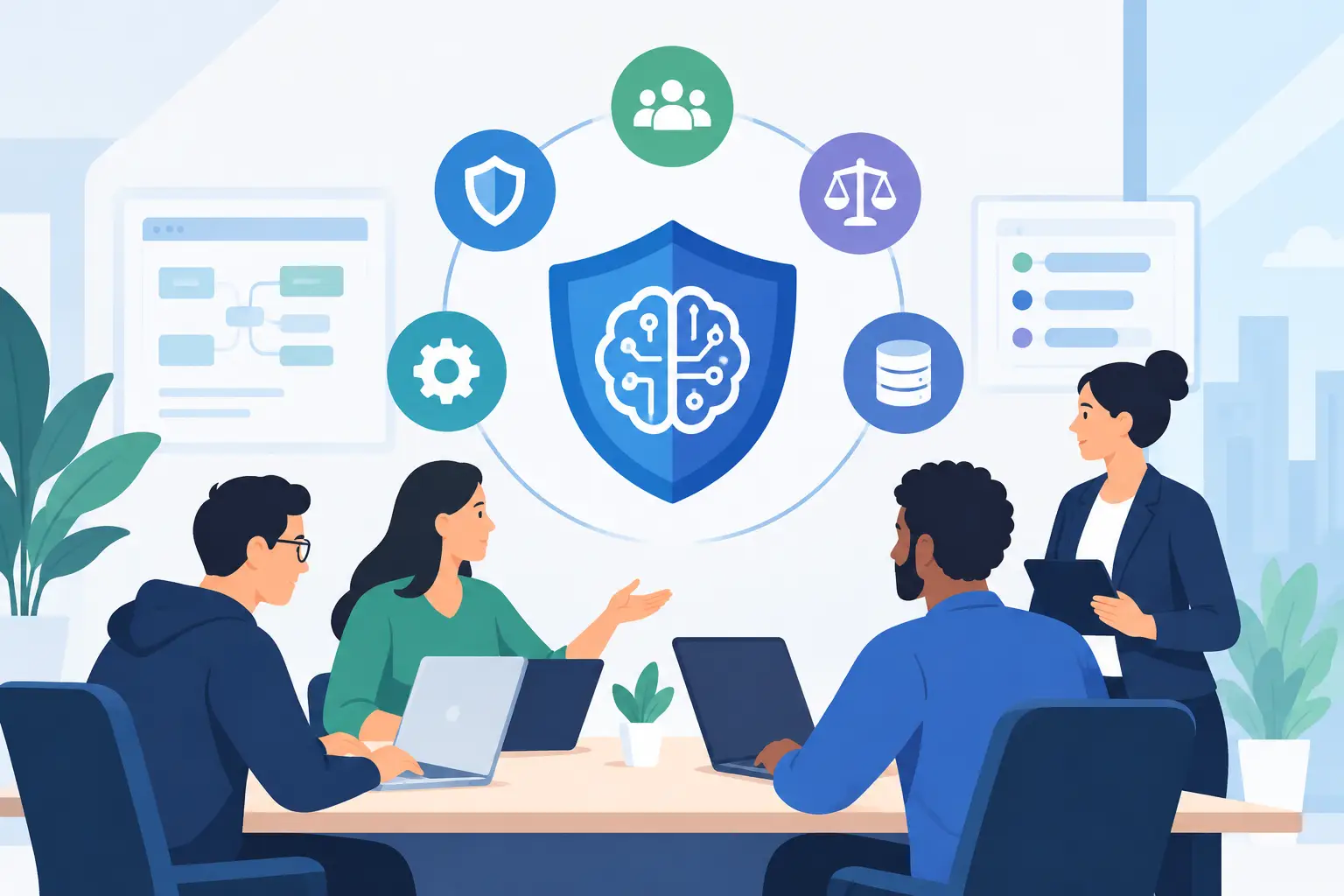
Every production AI system needs a named product or business owner and a technical owner. The product owner is accountable for intended use, user impact, and acceptable failure modes. The technical owner is accountable for implementation, integrations, monitoring, and change control. Security, privacy, legal, and compliance teams should provide guardrails and escalation paths, especially for higher-risk use cases.
This division avoids a common failure mode: everyone assumes someone else approved the data flow or checked the model’s behavior. Governance works best when decision rights are explicit. For example, platform engineering may approve shared model gateways, security may define approved authentication patterns, and individual product teams may choose prompts and evaluations within those boundaries.
Make AI Controls Part of Delivery
The most effective AI governance controls live in the development lifecycle, not in a spreadsheet after release. Treat prompts, model configurations, retrieval settings, and evaluation sets as versioned artifacts. Review them like application code. A small prompt change can alter how an agent interprets requests or which tools it calls.
Before deployment, evaluate the system against scenarios that reflect production conditions. Include normal requests, ambiguous requests, adversarial instructions, sensitive-data attempts, malformed inputs, and known failure cases. For a support assistant, that may include requests to reveal account details or instructions embedded in uploaded attachments. For a code-generation tool, test insecure patterns, dependency hallucinations, and licensing-sensitive output where relevant.
Automated evaluation is valuable, but it should not be mistaken for a final verdict. Model-based graders can be inconsistent, and benchmark scores can hide failures that matter to users. Combine automated checks with targeted human review, particularly for high-impact workflows. Keep the evaluation cases after launch so regressions are visible when a model, prompt, or retrieval pipeline changes.
Control data and tool access
Data governance remains central even when a team uses a third-party foundation model. Know what is sent to the provider, how it is retained, whether it may be used for training, and which regional or contractual requirements apply. Minimize the data included in prompts, redact fields where possible, and separate environments so test traffic does not become an accidental path for production records.
Tool-using agents need an even stricter approach. Give each agent only the permissions required for its task. Prefer scoped service identities over broad user credentials, validate tool parameters server-side, and require confirmation for irreversible actions. An agent should not be able to delete cloud resources because it was asked to summarize an incident.
Monitor the System You Actually Shipped
Production monitoring should cover more than latency and token usage. Track refusal rates, tool-call failures, retrieval quality, policy violations, user corrections, escalation frequency, and output formats. Logs must be useful for investigation, but they also need privacy controls. Store only what is necessary, limit access, and define retention periods.
Set thresholds that trigger a response. A sudden jump in failed structured outputs may indicate a provider change. An increase in users correcting an assistant’s answers may point to stale source material. A spike in blocked prompt-injection attempts may warrant a security review even if no breach occurred.
Incident response plans should state how to disable a model feature, revoke tool access, roll back a prompt or model version, notify affected stakeholders, and preserve evidence. These capabilities are easier to build before an incident than during one. Feature flags, kill switches, and clear runbooks turn governance from a policy document into operational resilience.
AI Governance Is a Product Advantage
Teams sometimes view governance as the price of using AI. Done poorly, it can become exactly that: a slow approval queue that encourages workarounds. Done well, it becomes a reusable engineering platform. Shared model gateways, approved data-handling patterns, evaluation tooling, audit logs, and deployment templates allow product teams to build with less uncertainty.
The strongest programs also accept that requirements will change. New model capabilities, regulations, vendor terms, and attack techniques will keep reshaping the risk landscape. Review controls on a regular cadence, learn from production incidents and near misses, and retire rules that no longer reduce meaningful risk.
A trustworthy AI feature is not one that claims it will never make mistakes. It is one whose team can explain its purpose, constrain its access, measure its behavior, and act quickly when reality differs from expectations.