
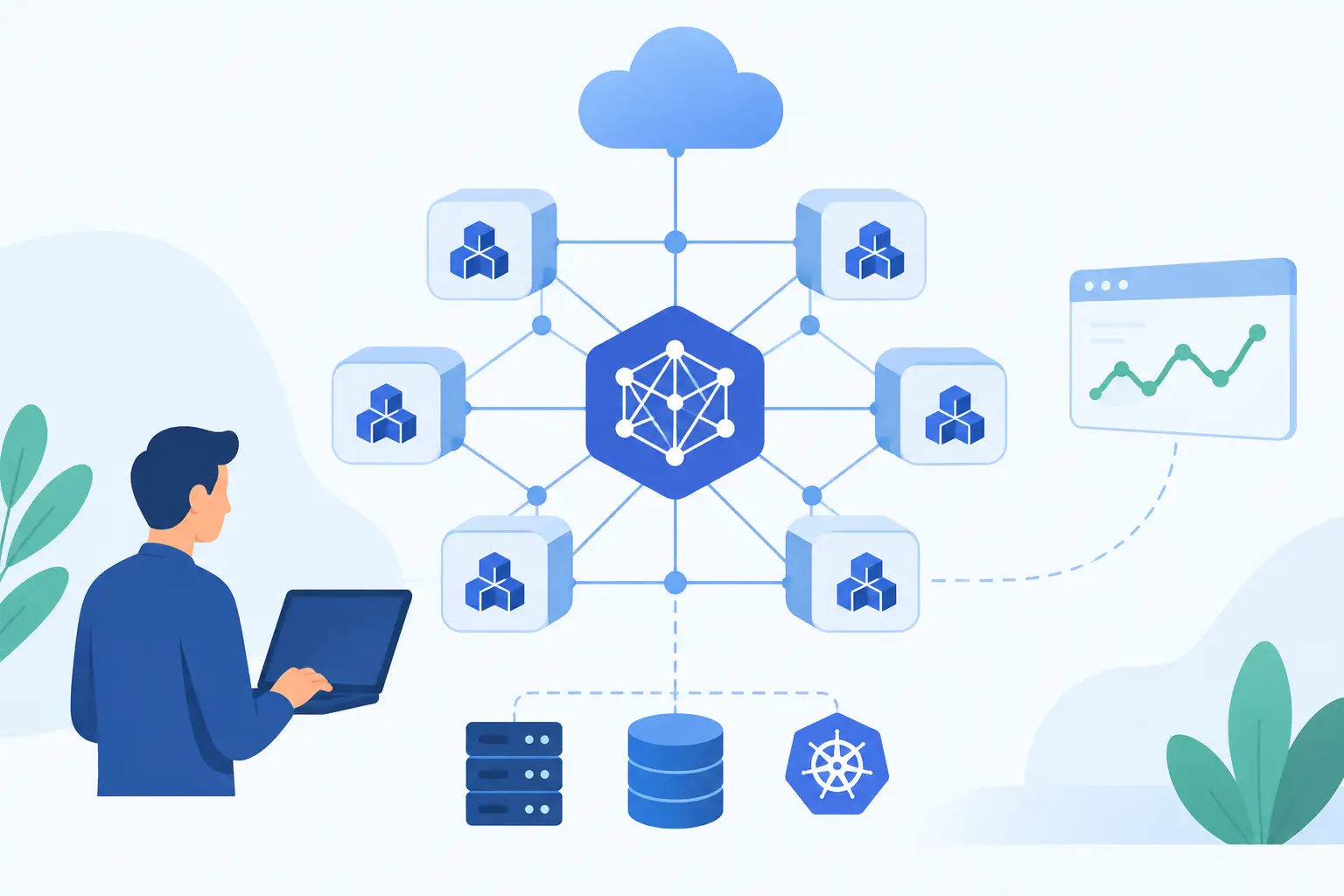
A checkout service calling inventory, pricing, recommendations, fraud detection, and payments can create dozens of network interactions in a single customer request. When one dependency slows down, teams need to know where the delay started, whether retries are making it worse, and how to protect the rest of the application. That is the operational problem behind the question, what is service mesh?
A service mesh is infrastructure that manages service-to-service communication in a distributed application. Rather than requiring every application team to write the same networking, security, and observability code into every service, the mesh moves many of those concerns into a dedicated platform layer.
For microservice environments, that separation can make traffic behavior more consistent and easier to operate. It can also introduce meaningful complexity. A service mesh is not a default requirement for every Kubernetes cluster or every application with APIs.
What Is Service Mesh in a Microservices Architecture?
A service mesh controls the traffic moving between application services. It typically handles how services find each other, how requests are routed, how identities are verified, how connections are encrypted, and how telemetry is collected.
The application still owns business logic. A product catalog service still looks up products, and an order service still creates orders. The mesh focuses on the network behavior around those calls: timeouts, retries, load balancing, access policies, encryption, and request-level metrics.


Most service mesh implementations use a data plane and a control plane. The data plane processes live application traffic. In a traditional sidecar model, a lightweight proxy runs next to each workload instance and intercepts inbound and outbound requests. The control plane distributes configuration and policies to those proxies.
This architecture lets an operations or platform team define consistent traffic and security behavior without asking every development team to modify its application framework, HTTP client, or language-specific libraries. Some newer designs use node-level proxies or other approaches to reduce the overhead of a sidecar per workload, but the core idea remains the same: application communication is managed through a shared infrastructure layer.
Why Teams Adopt a Service Mesh
As a system grows, service communication becomes an operational concern rather than a simple coding detail. Teams may use different languages, frameworks, deployment schedules, and client libraries. One service might implement retries carefully, while another retries too aggressively. One team may emit detailed traces, while another exposes only basic logs.
A mesh can establish common behavior at the platform level. For example, it can enforce mutual TLS between services, apply a consistent timeout policy, and generate metrics showing request volume, error rates, and latency across service boundaries.
This is particularly useful when a production incident crosses multiple teams. If an API gateway is healthy but customer requests are failing downstream, operators need a clear view of the call path. Mesh telemetry can show whether the failure is caused by a DNS issue, an overloaded dependency, a policy denial, a connection reset, or an upstream service returning errors.
The value is not merely more dashboards. It is reducing the amount of custom networking logic and inconsistent operational behavior spread across the codebase.
Traffic management and safer releases
A service mesh can route traffic based on rules that are more specific than a basic load balancer configuration. Teams can send a small percentage of requests to a new service version, route internal users to a preview release, or split traffic between regions and versions.
This supports canary deployments and progressive delivery. Instead of sending all production traffic to version 2 at once, a team might send 5 percent of requests to the new version, watch latency and error rates, then increase the share only when the data supports it.
Traffic management can also improve resilience. A mesh may provide outlier detection to temporarily avoid unhealthy instances, connection pooling to reduce connection costs, and circuit-breaking controls to stop a struggling dependency from consuming all available resources.
These capabilities still require thoughtful configuration. Retries, for example, can help with brief network failures but can amplify load during an outage. Retrying a non-idempotent payment operation can be dangerous unless the application has appropriate safeguards. A service mesh provides controls, not automatic architectural judgment.
Security through workload identity
Service-to-service security becomes difficult when teams rely on static credentials, ad hoc network rules, and assumptions that traffic inside a private cluster is trustworthy. A service mesh can give workloads verifiable identities and use mutual TLS, often called mTLS, to encrypt traffic and authenticate both sides of a connection.
With mTLS enabled, the calling service proves its identity to the receiving service, and the receiving service proves its identity in return. Teams can then write policies such as allowing the order service to call payment APIs while preventing an unrelated reporting service from doing the same.
This approach supports zero-trust principles inside the application network. It does not remove the need for API authorization, secrets management, secure coding, or network segmentation. It adds a strong, consistent layer for workload-to-workload communication.
Observability without rewriting every service
Distributed tracing, metrics, and access logs are essential when a single request travels through many services. Without shared instrumentation, tracing can become incomplete or vary by language and team.
A mesh proxy can capture request metadata at each hop, including latency, response codes, retry attempts, and source and destination identities. That data helps operators answer practical questions: Which service is adding latency? Is the issue limited to one deployment? Did errors begin after a traffic shift?
Application-level telemetry still matters. A proxy can tell you that a request failed with a 500 response, but only the application can explain that a required business record was missing or a validation rule rejected the request. The strongest observability strategy combines mesh-level network visibility with meaningful application logs, traces, and metrics.
Where a Service Mesh Fits in the Platform Stack
A service mesh overlaps with several familiar technologies, but it does not replace all of them.
Kubernetes provides service discovery, workload scheduling, basic networking, and deployment primitives. A mesh extends those capabilities with finer-grained traffic policy, identity-aware security, and richer service communication telemetry. Kubernetes is a common environment for service meshes, but a mesh can also support workloads outside Kubernetes depending on the product and architecture.
An API gateway primarily manages traffic entering an application from external clients, partner systems, or mobile apps. A service mesh primarily manages east-west traffic between internal services. Many organizations use both: the gateway handles north-south traffic at the edge, while the mesh governs internal calls.
Libraries can provide retries, tracing, and circuit breakers inside application code. They may be the better option for a smaller system because they are explicit and lightweight. A mesh centralizes these concerns, which becomes more appealing as the number of services, teams, and languages increases.
When a Service Mesh Is Worth the Cost
A service mesh is most compelling when service communication is already a major operational challenge. That usually means many independently deployed services, multiple teams, strict internal security requirements, or frequent releases that need controlled traffic shifts.
It can be a good fit when your organization needs consistent mTLS across services, has difficulty tracing cross-service failures, or wants a platform-level way to standardize timeouts, retries, and traffic policies. It is also valuable for teams running multi-cluster or multi-region systems where service identity and routing need to work across a larger footprint.
It may be unnecessary when an application is a modular monolith, has only a few services, or has limited operational maturity. Adding proxies, control-plane components, certificates, policies, and new debugging workflows can make a simple environment harder to understand. Resource overhead also matters, especially for workloads with tight CPU and memory budgets.
The decision should start with a specific pain point, not a tool trend. If your biggest reliability issue is a poorly designed database schema or an overloaded shared dependency, a mesh will not fix the root cause. If the recurring issue is inconsistent service communication policy across dozens of workloads, it can be a strong platform investment.
How to Introduce a Service Mesh Carefully
Treat service mesh adoption as a platform change, not a quick networking upgrade. Begin with a small set of noncritical services and define what success looks like. That might mean proving that mTLS works without application changes, reducing mean time to diagnose failed requests, or validating a canary deployment workflow.
Start with observability before enforcing complex traffic and security policies. Teams need to understand how the mesh represents requests, how to inspect proxy behavior, and where to look when traffic fails. Establish clear ownership as well: platform engineers may operate the mesh, but service teams still own application behavior and must understand the policies affecting their workloads.
Keep policies intentionally simple at first. Default timeouts, limited retries for safe operations, service identity, and basic telemetry deliver more value than an early attempt to model every possible routing exception. As confidence grows, expand to progressive delivery, authorization controls, and multi-cluster communication.
A service mesh earns its place when it makes distributed systems easier to reason about under pressure. If it gives developers clearer signals and gives platform teams safer control over service traffic, it becomes more than another cluster component. It becomes a practical foundation for operating software that has outgrown simple point-to-point connections.