
A checkout endpoint receives ten requests most days, then 20,000 during a product launch. A background worker needs 15 minutes to transform uploaded video. A customer-facing API must keep predictable response times under sustained traffic. Treating those three workloads as the same deployment problem is where architecture gets expensive.
The serverless vs containers deployment decision is not really about which technology is more modern. It is about how much infrastructure control your team needs, how uneven demand is, and where operational complexity should live. Both approaches can produce secure, scalable cloud applications. Their differences become clear when you examine runtime limits, cost behavior, deployment ownership, and the shape of the workload.
What Each Deployment Model Actually Manages
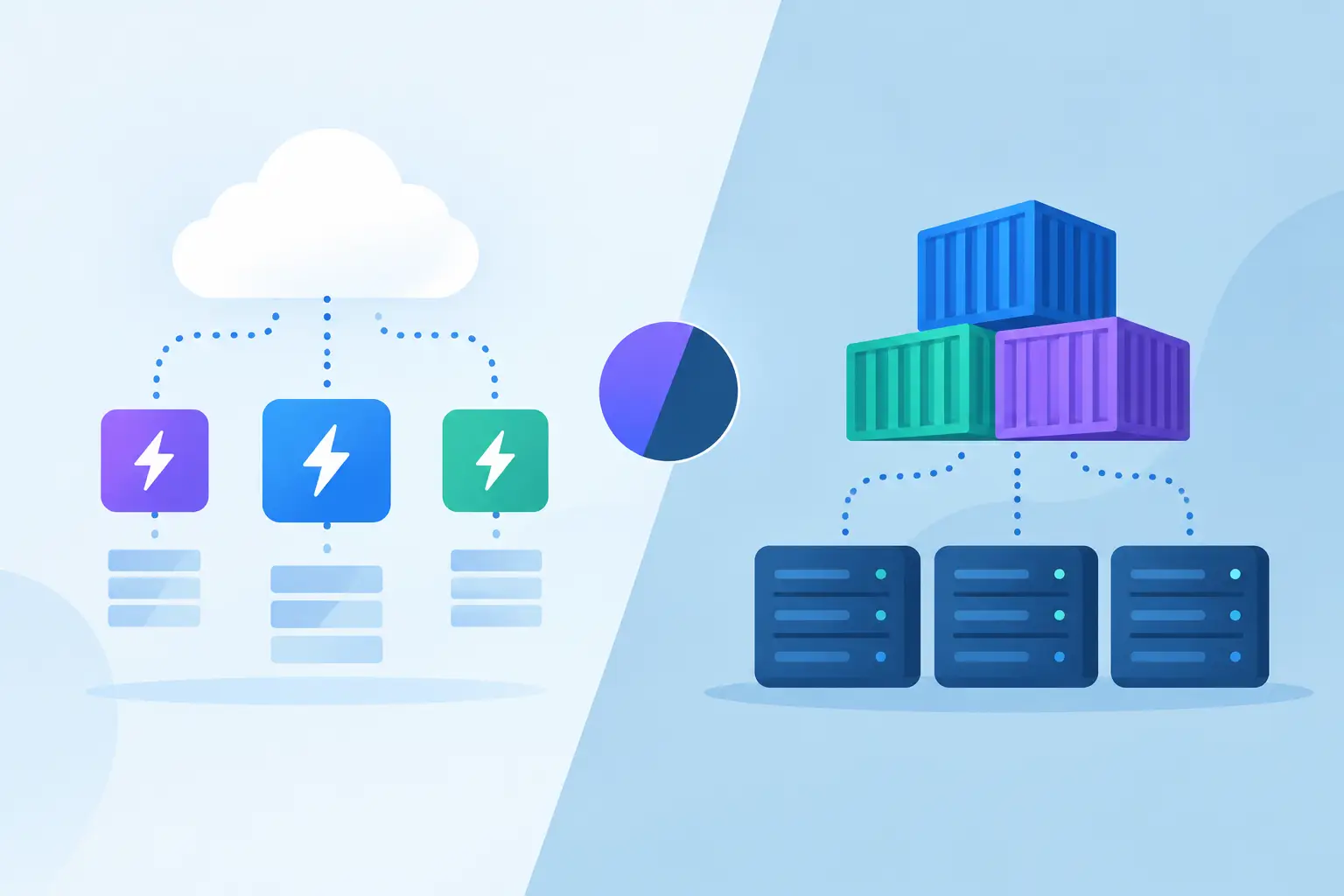
Serverless usually means deploying code as functions or managed application units that run in response to events or requests. The cloud provider provisions compute, scales instances, and stops charging for idle execution in many cases. A function might run when an HTTP request arrives, a file lands in object storage, a queue receives a message, or a database record changes.
Containers package an application and its dependencies into a consistent runtime image. That image can run on a managed container platform, a container orchestration service, or Kubernetes. The platform still may handle cluster capacity and scaling, but the team defines more of the application environment: the base image, process model, networking behavior, runtime configuration, and often health checks.
This distinction matters because serverless removes more infrastructure decisions by design. Containers preserve more flexibility. Neither choice eliminates operations. Serverless shifts operations toward event design, permissions, observability, and service limits. Containers shift them toward image supply chains, resource sizing, runtime reliability, and platform configuration.


Serverless vs Containers Deployment: The Core Trade-Offs
The simplest way to frame the comparison is control versus operational abstraction. Serverless provides a highly managed execution model. Containers give teams a portable and configurable unit of deployment.
Scaling behavior
Serverless platforms are built for rapid, event-driven scaling. If an API function suddenly receives thousands of independent requests, the platform can create concurrent executions without a team pre-provisioning application instances. This is especially useful for bursty traffic, scheduled jobs, webhook handlers, ingestion pipelines, and lightweight APIs.
Container platforms can also autoscale effectively, but the configuration is more deliberate. Teams commonly set minimum and maximum replicas, CPU and memory thresholds, concurrency limits, and scaling policies. That work pays off for long-running services with steady demand because you can tune performance around known usage patterns.
The caveat is startup latency. Serverless functions may experience cold starts when a runtime has to initialize, particularly with larger dependencies, certain language runtimes, VPC networking, or low traffic. Managed containers can also start slowly, but teams have more options to optimize image size, keep a minimum number of instances warm, and control initialization behavior.
Cost behavior
Serverless pricing is compelling when code runs intermittently. A function that executes only when users upload documents may cost far less than an always-on service. Billing typically follows invocations, execution time, memory allocation, and related services such as API gateways, queues, logs, and databases.
For stable, high-throughput workloads, the economics can reverse. A continuously busy API may be cheaper on containers, especially when reserved capacity or predictable compute commitments are available. The right comparison is not a single request price. Model the full system: idle time, peak concurrency, data transfer, managed gateway costs, logging volume, build infrastructure, and the engineering time required to operate it.
Runtime and application fit
Serverless functions work best when responsibilities are small, stateless, and event-oriented. A request validator, image thumbnail generator, email processor, or queue consumer maps naturally to the model. Functions can support larger applications, but forcing a deeply interconnected monolith into dozens of functions can create difficult local development, tracing, and deployment coordination.
Containers are a stronger fit for applications that need custom binaries, unusual libraries, long-lived connections, background processes, specialized networking, or runtime behavior outside function limits. They are also often easier to adopt for existing applications. Moving a web service into a container may require fewer code changes than restructuring it around function triggers and event contracts.
Operational responsibility
Serverless reduces the need to patch servers and manage process supervisors. That is valuable for lean teams, but it does not remove production discipline. Teams still need least-privilege IAM policies, dead-letter handling, idempotent event processing, structured logging, distributed tracing, and alerts tied to user impact.
With containers, teams must additionally maintain images, scan dependencies, manage registry access, set resource requests and limits, and plan for failed instances. Kubernetes offers extensive control, but it can be an oversized platform for a small service. A managed container runtime can be a useful middle ground: container flexibility without operating every part of a cluster.
Choose Serverless When Events Drive the Work
Serverless is often the practical choice when demand is unpredictable and tasks have a clear start and finish. Consider a SaaS product that processes invoices after upload. An object storage event can trigger validation, extract metadata, place work on a queue, and invoke a processing function. Each stage can scale independently, and the company does not need to keep workers running overnight when no invoices arrive.
It also works well for integration-heavy systems. Webhooks, scheduled maintenance tasks, data synchronization jobs, notification pipelines, and IoT messages are naturally event-driven. The architecture benefits most when functions remain focused and when retries do not create duplicate side effects.
Before committing, confirm the platform’s execution duration, payload size, concurrency quotas, networking constraints, and supported runtimes. A workflow with slow external dependencies or large media files may need orchestration, queues, and dedicated compute rather than a single function trying to do everything.
Choose Containers When the Service Owns Its Runtime
Containers make sense when the application needs consistent control over its operating environment. A Java service with a substantial startup sequence, a real-time service using persistent connections, or a machine learning inference API with custom system libraries may be much easier to run as a container.
They are also a sound choice for teams standardizing across cloud providers or on-premises environments. Containers do not guarantee portability by themselves – managed databases, identity systems, load balancers, and observability tooling still create dependencies – but the application runtime is easier to move and test consistently.
For a mature API with constant traffic, containers can offer predictable latency and cost. Keep at least a baseline capacity running, autoscale for demand, and use health checks to replace unhealthy instances. The operational model is more involved than serverless, but it is explicit and tunable.
Security and Delivery Practices Apply to Both
Security should not be treated as a differentiator that automatically favors one model. Serverless reduces host-level maintenance, while containers expose a more visible software supply chain. Both can fail through overly broad permissions, exposed secrets, vulnerable dependencies, or insecure network assumptions.
For serverless, scope each function’s permissions to the exact queues, buckets, database tables, and secrets it needs. Avoid giving every function broad account-level access simply because it speeds up early development. Design for retries by using idempotency keys and durable event records where necessary.
For containers, use minimal trusted base images, pin and scan dependencies, run as a non-root user, and enforce image signing or admission controls where the platform supports them. Set CPU and memory boundaries so one workload cannot exhaust shared capacity. In both models, centralize secrets, log meaningful security events, and test infrastructure configuration as code.
Deployment pipelines should reflect the model as well. Functions benefit from small, independently deployable units and contract tests for event payloads. Container services benefit from reproducible image builds, vulnerability gates, staged rollouts, and rollback strategies. Feature flags and canary releases remain useful regardless of the runtime.
A Hybrid Architecture Is Often the Better Answer
Many production systems use both approaches because their workloads are different. A containerized API can handle long-lived user sessions and complex request processing. Serverless functions can resize uploaded images, send notifications, process queue messages, and run scheduled cleanup jobs. The shared foundation is not deployment style but clear boundaries, reliable events, and observable service behavior.
Avoid choosing a platform solely because it promises fewer servers or more flexibility. Start with the workload’s execution time, traffic pattern, state requirements, latency target, and failure mode. Then pilot one bounded service, collect real cost and performance data, and make the next deployment choice with evidence rather than architecture fashion.