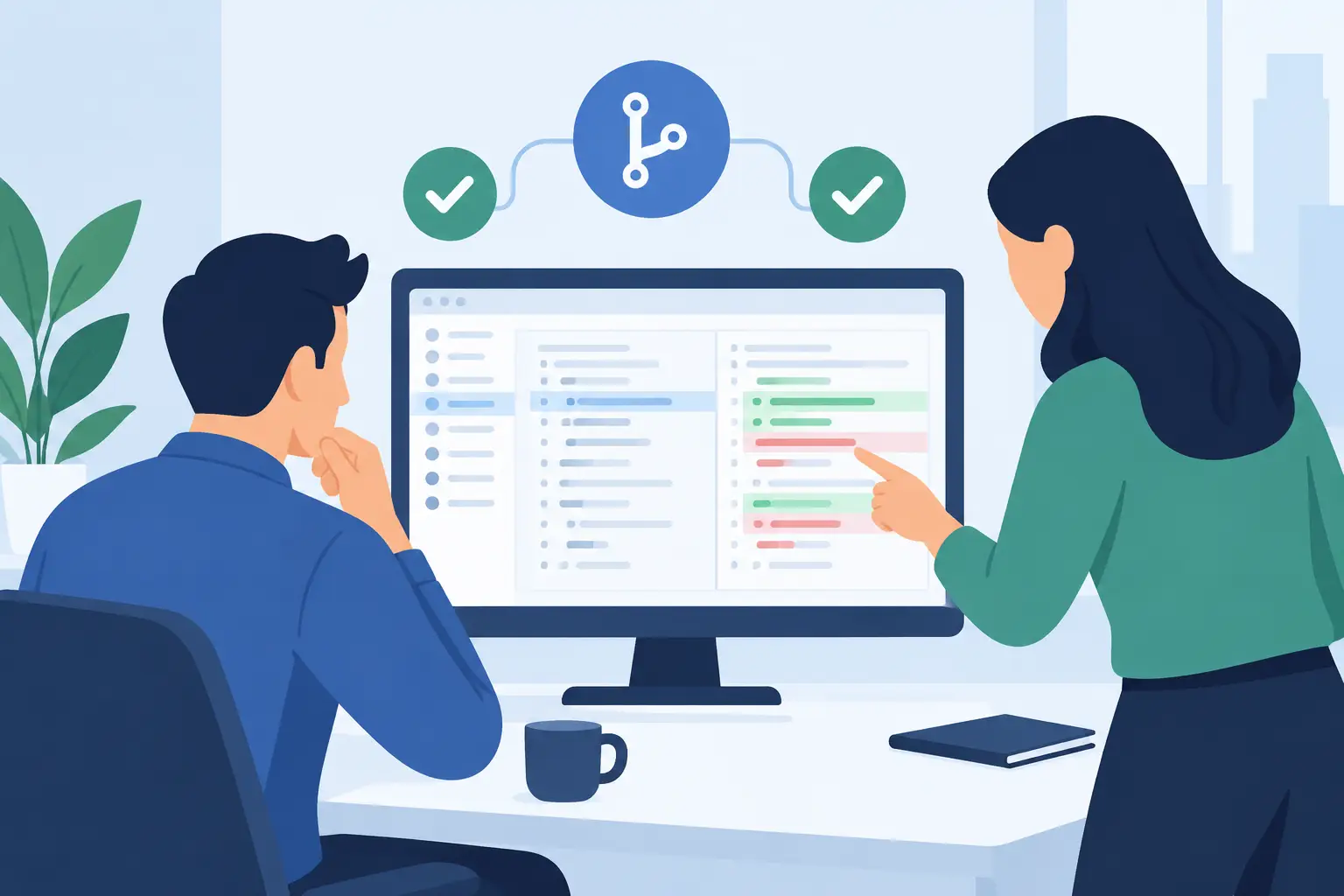
A pull request can either be a fast, high-signal engineering conversation or a queue where useful work waits for approval. The difference is rarely a code hosting platform. It comes from how a team applies the best code review practices: clear change scope, informed reviewers, constructive feedback, and an agreed definition of done.
Code review is not a ceremonial final gate. Done well, it is a design checkpoint, a knowledge-sharing system, and an early-warning mechanism for reliability and security issues. Done poorly, it encourages superficial approvals, delayed releases, and frustrated developers who stop asking for meaningful feedback.
Start With a Reviewable Pull Request
The reviewer experience begins before anyone opens the diff. A pull request that mixes a schema migration, a component redesign, formatting changes, dependency updates, and a bug fix asks reviewers to hold too much context at once. That increases the chance that a real defect is missed because attention has been spent sorting out unrelated changes.
Keep pull requests small enough that a reviewer can understand the intent, trace the important execution paths, and test assumptions without setting aside half a day. There is no universal line-count limit. A 500-line generated migration may be easy to review, while a 60-line change to authentication or payment logic may require deep scrutiny. Scope and risk matter more than raw size.
A useful pull request description explains what changed, why it changed, and how it was verified. Include relevant architecture decisions, screenshots for visible UI changes, rollout considerations, and any areas where the author wants focused feedback. If a compromise was necessary, state it directly. Reviewers should not need to reverse-engineer business context from a ticket title and a diff.
Before requesting review, authors should run formatting, linting, tests, static analysis, and security checks locally or through continuous integration. Automated checks do not replace human review, but they remove low-value discussion about spacing, unused imports, and mechanical failures. That leaves people free to assess behavior, maintainability, and operational impact.
Best Code Review Practices Begin With Shared Standards
Teams often struggle with reviews because every developer is applying a different, unstated standard. One reviewer may focus on naming, another on edge cases, and another on whether the change aligns with the architecture. All of those concerns can be valid, but inconsistency makes feedback feel arbitrary.
Create lightweight review guidance that defines what the team expects. It should cover code style, testing expectations, error handling, observability, security-sensitive changes, API compatibility, and ownership boundaries. Keep it short enough to use during actual reviews. A twenty-page policy that nobody consults will not improve engineering quality.
It also helps to distinguish blockers from suggestions. A blocker means the change should not merge until the issue is addressed, such as an authorization bypass, a broken failure path, or a backward-incompatible API response. A suggestion is an improvement that may be worth making now, tracking separately, or declining with a reason. Teams that blur these labels turn every preference into a release risk.
Review standards should evolve after incidents and recurring review discussions. If production failures repeatedly stem from missing timeouts, unclear ownership, or unsafe database changes, add targeted checks to the team’s working agreement. This turns operational lessons into a repeatable engineering practice.
Review for Intent, Not Just Syntax
The most valuable reviews move beyond asking whether code compiles. Start by understanding the requested outcome. Is the implementation solving the stated problem? Does it preserve existing behavior that clients, services, or users depend on? Is there a simpler design that reduces future maintenance?
Then examine the paths that tend to fail in production: invalid input, empty results, retries, concurrent updates, partial service failures, expired credentials, and unexpected response formats. Happy-path logic is usually easy to read. Failure behavior is where distributed systems, cloud services, and asynchronous workflows reveal their complexity.
For changes that touch APIs, reviewers should look closely at contracts. A renamed field, altered default value, changed pagination behavior, or new validation rule can break consumers even when unit tests pass. Versioning strategy, deprecation plans, and compatibility tests belong in the discussion when an interface is shared outside one codebase.
Security deserves the same contextual thinking. Rather than asking only whether a secret appears in the diff, consider trust boundaries. Does the new endpoint enforce authorization? Can user-controlled input reach a query, shell command, file path, or browser output? Are logs exposing personal data or tokens? A reviewer does not need to be a dedicated security engineer to identify a risky data flow and request a deeper assessment.
Choose Reviewers by Context and Risk
Assigning the nearest available reviewer may be fast, but it is not always effective. The best reviewer is often someone who understands the affected domain, owns a dependent service, or has experience with the relevant infrastructure. A database migration may need a platform or data engineer. A new browser-facing API may benefit from review by the team that consumes it.
That said, reviews should not create permanent bottlenecks around a single expert. Rotate reviewers intentionally and use reviews to spread domain knowledge. Pairing a newer engineer with an experienced owner can improve the immediate change while reducing future dependency on one person.
Risk should shape the level of scrutiny. A copy update can receive a lighter review than a change to identity flows, financial calculations, infrastructure permissions, or destructive data operations. Higher-risk changes may need multiple reviewers, a test plan, staged rollout details, feature flags, or explicit rollback steps. This is not bureaucracy for its own sake. It is a proportionate response to blast radius.
Write Feedback That Leads to Better Code
A review comment should help the author understand the concern and make a decision. Comments such as “bad,” “clean this up,” or “why?” create friction without offering direction. Point to the behavior, explain the risk, and suggest an alternative when one is clear.
For example, instead of writing, “This is wrong,” write: “If the cache is unavailable, this path returns a 500 even though the source service is still reachable. Should we fall back to the source and emit a metric?” The second comment identifies the scenario, connects it to user impact, and opens a technical conversation.
Tone matters because review is a repeated team interaction. Ask questions when intent is unclear, acknowledge good decisions, and avoid treating personal preference as objective truth. Direct feedback is still necessary, especially for correctness and security problems, but it can be direct without being dismissive.
Authors have responsibilities too. Respond to each comment, even when the answer is to defer an idea or choose a different approach. Explain decisions briefly, push follow-up work into a visible task when appropriate, and avoid resolving threads before the reviewer can confirm the response. A clean thread list should reflect a shared resolution, not an attempt to end discussion.
Protect Flow With Review Service Levels
A technically excellent review process fails when pull requests wait for days. Delayed feedback increases merge conflicts, makes context stale, and encourages developers to bundle more changes into each request. Teams need an explicit expectation for review responsiveness, such as acknowledging requests within a few working hours and completing normal reviews within one business day.
Service levels need flexibility. Incidents, deadlines, and deep architectural changes can interrupt normal cadence. But a visible review rotation, backup reviewers, and protected time for reviewing prevent code review from becoming invisible labor performed only after everyone finishes their primary work.
Avoid reviewing only in large, end-of-day batches. Early review of a design-sensitive pull request can catch a flawed direction before implementation expands. For larger work, request feedback on a design note, an interface, or the first vertical slice rather than waiting for every detail to be complete.
Use Automation as a Filter, Not a Substitute
Automation is most useful when it makes human attention more valuable. Build checks can validate tests, formatting, dependency vulnerabilities, license policies, infrastructure configuration, and basic static-analysis rules. Branch protections can prevent merging when required checks fail or required approvals are missing.
However, automated approval signals have limits. A green pipeline cannot determine whether an abstraction fits the system, whether an API change is safe for downstream users, or whether a retry strategy will amplify load during an outage. Treat automation as the baseline filter and human review as the place where engineering judgment is applied.
AI-assisted review tools can also help identify patterns such as duplicated logic, missing null checks, or questionable query construction. Their findings should be verified, particularly in unfamiliar repositories. The tool may lack business context, misunderstand a framework convention, or produce noisy suggestions that distract from higher-risk concerns.
Measure the Process, Then Improve It
Review quality is difficult to reduce to a single metric, but teams can identify friction by tracking a few signals: time to first review, total time to merge, pull request size, rework caused by review, reverted changes, and recurring production defects. Numbers should reveal process problems, not become a scorecard for individual developers.
If reviews are slow, investigate why. The issue may be oversized pull requests, unclear ownership, overloaded specialists, weak test environments, or too many required approvers. If comments are mostly stylistic, improve automated formatting and refocus human reviewers on behavior. If defects escape frequently, examine whether the team is reviewing the right failure modes.
Strong code review is a habit built through small, repeatable decisions: submit focused changes, give reviewers the context they need, respond quickly, and treat every thoughtful comment as an investment in the next release. The result is not just cleaner code, but a team that can make complex changes with greater confidence.