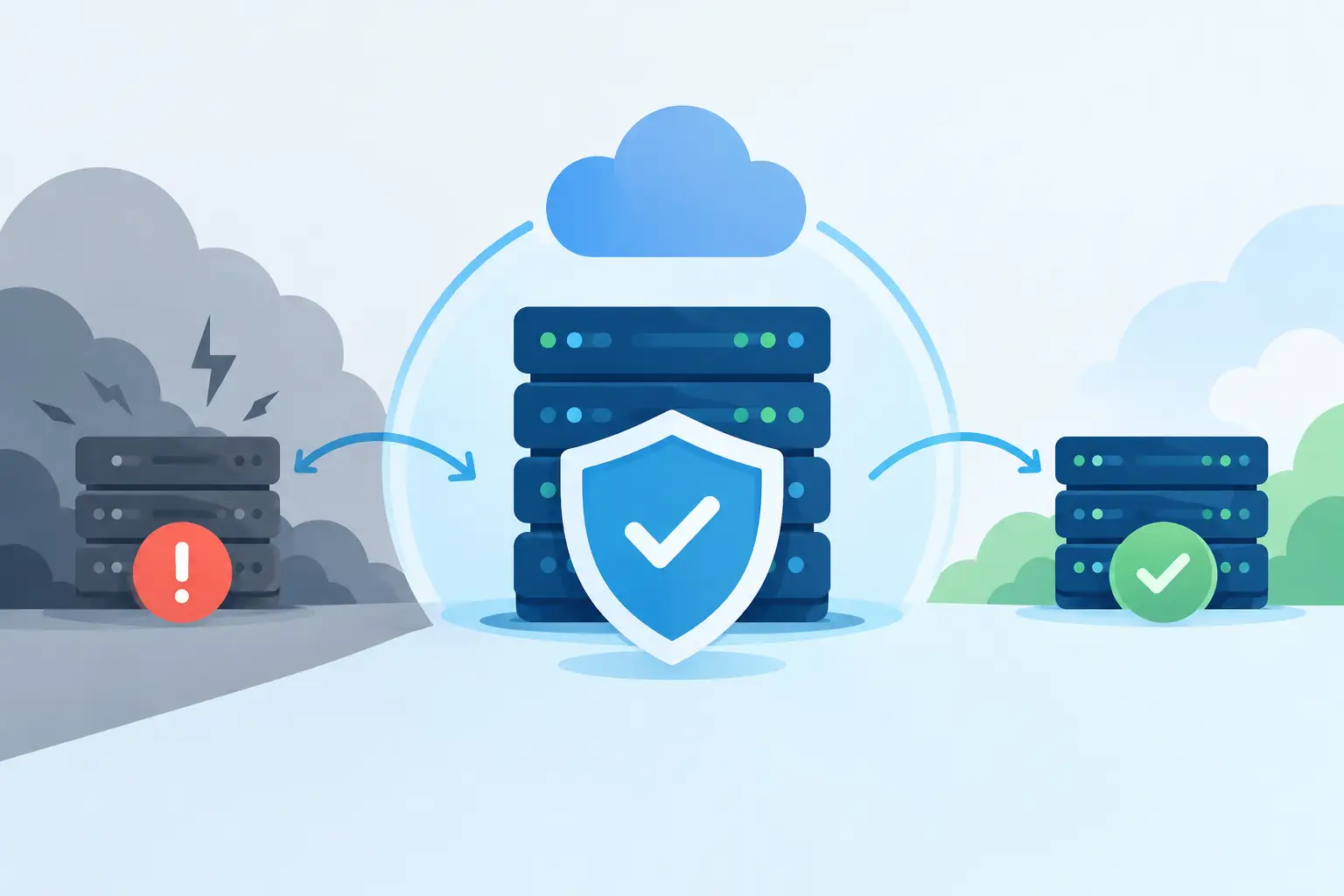
A payment provider slows down for 90 seconds. A deployment changes one configuration value. A database connection pool reaches its limit. None of these events should automatically become a customer-facing outage. That expectation is the core of software resilience: designing systems that can absorb disruption, continue delivering their most important functions, and recover without prolonged manual intervention.
Availability targets matter, but uptime alone does not describe how a system behaves under pressure. A service can report as available while returning stale data, timing out at checkout, or overwhelming a dependency with retries. Resilience asks a more useful question: when something fails, what happens next?
What Software Resilience Actually Means
Software resilience is the ability of an application and its supporting infrastructure to anticipate failure, limit its blast radius, adapt during disruption, and restore normal operation. It is not a single cloud feature, a circuit breaker library, or a promise that failures will never occur. Distributed systems fail in ordinary ways: networks add latency, dependencies return errors, machines restart, credentials expire, and traffic patterns change faster than capacity plans.
Reliable systems try to minimize failure. Resilient systems assume some failures will get through and make them manageable. The distinction matters when teams design for real operating conditions rather than ideal ones.
A resilient e-commerce platform, for example, might let customers browse cached product pages when its recommendation engine is unavailable. It may temporarily disable personalized offers, queue nonessential analytics events, and preserve the checkout path. The experience is degraded, but the business-critical workflow remains available.
This does not mean every feature deserves identical protection. A report that can be generated later has a different resilience requirement than authentication, payment authorization, or a medical alert. Teams need to identify critical user journeys before selecting patterns or setting service-level objectives.
Start With Failure Boundaries, Not Technology Choices
The most effective resilience work begins with architecture mapping. Trace a critical request from the user interface through APIs, databases, message brokers, third-party services, identity providers, and observability tools. For each dependency, ask what happens if it becomes slow, unavailable, inconsistent, or overloaded.
This exercise often exposes hidden coupling. A product catalog may depend on search, pricing, inventory, promotions, and feature-flag services before it can render a single page. If every request requires every downstream service to be healthy, the overall application becomes only as dependable as its weakest dependency.
Set explicit failure boundaries. A bounded context or independently deployable service should be able to fail without taking unrelated capabilities down with it. This may involve separate resource pools, isolated queues, independent scaling policies, and API contracts that allow partial responses.
There is a trade-off. Breaking a system into more components can improve isolation, but it also adds network calls, deployment complexity, and operational overhead. A modular monolith with clear internal boundaries can be more resilient than a poorly managed collection of microservices. Architecture should follow team maturity and operational needs, not fashion.
Define graceful degradation early
Graceful degradation should be a product decision as much as an engineering decision. Teams should agree on which functions must remain available, which can use cached or delayed data, and which should be disabled clearly when a dependency fails.
For a collaboration platform, that might mean users can read existing documents during a real-time sync outage but cannot make edits until the service recovers. For an internal dashboard, it may mean showing the last successful data refresh with a timestamp rather than presenting an empty chart as current information.
The key is honesty. A fallback that silently serves outdated or incomplete data can be worse than an error if it leads users to make the wrong decision.
Build Controls That Stop Failures From Spreading
Once failure modes are known, teams can add controls that prevent a local problem from becoming a system-wide event. These controls work together. Adding retries without timeouts, for instance, can turn a brief dependency slowdown into an overload event.
Timeouts establish how long a service is willing to wait. Every network call needs a realistic limit based on the user journey and the downstream service’s normal latency. Without a timeout, requests can accumulate until threads, connections, or compute resources are exhausted.
Retries can handle temporary faults, but they must be selective. Retry only operations that are safe to repeat or protected with idempotency keys. Use exponential backoff and jitter so thousands of callers do not retry at the same moment. Retrying a failed payment request without idempotency controls can create duplicate charges, which is not resilience.
Circuit breakers stop repeated calls to a failing dependency. When error or timeout rates exceed a threshold, the circuit opens and requests fail fast or use a fallback. After a defined interval, the system allows limited test requests to check whether the dependency has recovered. Circuit breakers protect both the caller and the troubled service.
Bulkheads isolate resource consumption. Separate connection pools, worker queues, thread pools, or compute limits ensure that one expensive workload cannot consume everything. If a report-generation job becomes stuck, it should not prevent checkout transactions from accessing the database.
Queues and asynchronous processing absorb bursts and decouple work that does not need an immediate response. Email notifications, image processing, analytics, and many integration tasks are good candidates. However, queues shift rather than erase risk. Teams still need dead-letter handling, idempotent consumers, back-pressure rules, and monitoring for growing backlogs.
Design Data Handling for Recovery
Many incidents are not caused by an application process crashing. They result from data problems: a partial write, a replayed event, an out-of-order message, or a schema change that one consumer does not understand.
Resilient data workflows treat duplicate delivery as normal. Idempotency keys, deduplication records, and carefully designed state transitions allow a process to run again without corrupting results. This is especially valuable in event-driven systems, where at-least-once delivery is common.
Data recovery also requires a tested backup strategy. A backup that has never been restored is a hopeful assumption, not a recovery plan. Define recovery point objectives to determine how much data loss is acceptable and recovery time objectives to set expectations for restoration. Then practice restoring representative datasets, including application configuration and encryption dependencies.
Schema evolution deserves the same care. Expand-and-contract migrations are often safer than immediate replacement. Add a compatible field or table structure, deploy consumers that understand both versions, migrate traffic and data, then remove the old path only after verification. This approach takes longer than a one-step change, but it reduces the chance that a deployment creates an irreversible data incident.
Observe the User Experience, Not Just Infrastructure
A green dashboard does not prove customers can complete their work. CPU utilization, memory use, and pod status are useful signals, but they need to be paired with application-level telemetry.
Track the health of critical journeys: successful logins, completed orders, accepted uploads, report generation times, and API error rates by endpoint. Use structured logs with correlation IDs, distributed traces across service boundaries, and metrics that distinguish client errors from server failures. Alerting should identify a meaningful symptom, not merely every unusual infrastructure event.
Good observability shortens the gap between detection and diagnosis. It also improves incident communication. When teams can state that checkout is affected in one region, that a fallback is active, and that queued orders are being preserved, responders and stakeholders can make better decisions.
Test the System Under Stress Before Production Does
Resilience is proven through evidence, not architecture diagrams. Load testing shows where latency rises as traffic grows. Failure injection reveals whether a timeout or circuit breaker works as intended. Game days let engineering, operations, security, and support teams rehearse a realistic incident together.
Start small. Introduce latency to a noncritical test dependency, terminate a disposable instance, or simulate a delayed message consumer. Verify the expected customer outcome, not just whether a technical component restarts. Then increase scope as confidence and safety controls improve.
A practical resilience program can progress in four steps:
- Map the top two or three customer journeys and their dependencies.
- Set timeouts, retry policies, and resource isolation for the highest-risk calls.
- Add service-level indicators that measure user-facing success and latency.
- Run recurring recovery and failure exercises, then turn findings into backlog work.
The goal is not to create chaos for its own sake. It is to replace assumptions with measurable behavior.
Make Resilience Part of Everyday Delivery
Software resilience declines when it is treated as a special project completed once a year. New dependencies, feature flags, database migrations, and traffic sources can all alter a system’s failure behavior. Resilience needs a place in design reviews, pull requests, release planning, and post-incident follow-up.
Before shipping a change, teams should be able to explain its dependency behavior, rollback path, monitoring signals, and failure mode. Progressive delivery techniques such as canary releases and feature flags can reduce deployment risk, provided the team can observe results and roll back quickly. A flag system that is itself a single point of failure needs its own fallback behavior.
The best next step is usually narrow and concrete. Choose one critical workflow, identify its most likely dependency failure, and make the user outcome safer. Repeating that practice turns resilience from an abstract architecture goal into a visible habit of engineering.