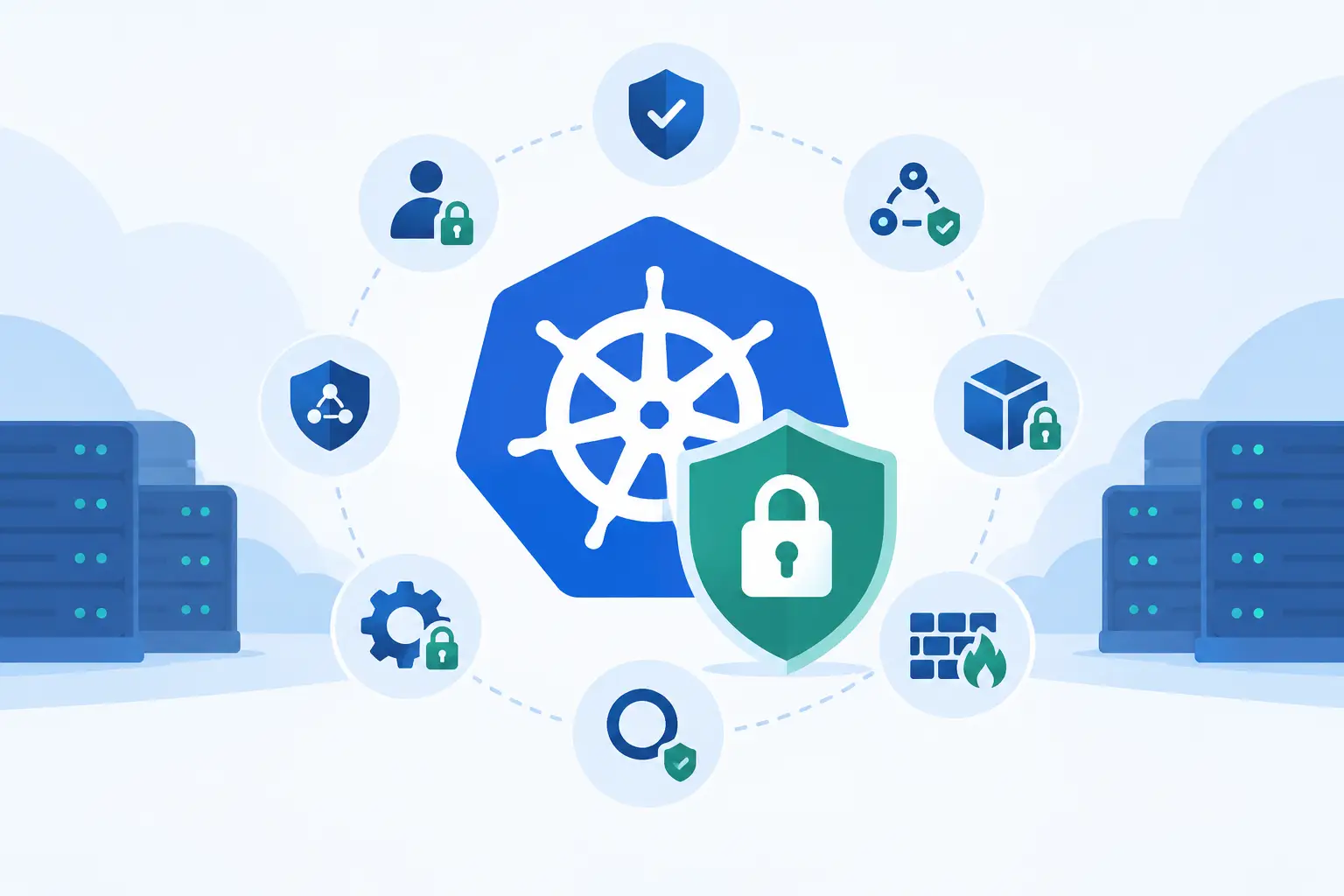
A Kubernetes cluster can turn a small configuration mistake into a broad production incident. A workload with an overly permissive service account, a public dashboard, or a container running as root may provide an attacker a route from one application to the wider environment. The essential Kubernetes security controls below help teams reduce that exposure without making deployment work unmanageable.
Kubernetes security is not a single tool or a one-time hardening sprint. It is a set of decisions across image building, identity, networking, runtime behavior, and operations. The practical goal is to make unsafe paths difficult by default, visible when they occur, and contained if they succeed.
Essential Kubernetes Security Controls for Production
1. Enforce least privilege with RBAC
Role-Based Access Control is the first boundary to review because Kubernetes credentials can be extremely powerful. Avoid granting broad `cluster-admin` access to people, service accounts, CI systems, or third-party controllers unless there is a documented reason and a short review cycle.
Start with namespace-scoped `Role` and `RoleBinding` resources whenever possible. A deployment pipeline that only releases to the `payments` namespace should not be able to read Secrets or create workloads across every namespace. Likewise, applications should use dedicated service accounts rather than the default account automatically assigned to pods.
RBAC can become difficult to maintain in large organizations. Teams often respond by adding wildcard permissions to make an error disappear. Instead, treat permission changes like code changes: review them, test them in nonproduction environments, and periodically identify unused roles and bindings. Least privilege is not a promise that no access will ever expand. It is a process for making expansion deliberate.

2. Protect the API server and cluster credentials
The Kubernetes API is the control plane’s front door. Restrict who can reach it, require strong authentication, and prevent long-lived credentials from spreading through developer machines and CI variables.
Use centralized identity where your platform supports it, such as OIDC integration with your organization’s identity provider. Prefer short-lived tokens over static client certificates or copied kubeconfig files. For managed Kubernetes offerings, also restrict API access by private endpoint or approved network ranges when that fits the operating model.
Separate human and machine identities. A CI runner needs narrowly defined deployment permissions, not an engineer’s personal credentials. Audit logs should capture API activity, especially authentication failures, privilege changes, Secret reads, exec requests, and new role bindings. These events are often the most useful evidence during an investigation.
3. Apply Pod Security Standards at admission time
A secure image can still be deployed with unsafe runtime settings. Kubernetes Pod Security Standards provide a clear baseline for preventing common high-risk configurations, including privileged containers, host networking, host path mounts, and containers that run as root.
For most application namespaces, the restricted profile is a strong target. It pushes workloads toward non-root users, dropped Linux capabilities, a read-only root filesystem where feasible, and blocked privilege escalation. Some infrastructure components may need exceptions, particularly storage, networking, or observability agents. Keep those exceptions in dedicated namespaces and document why they exist.
Use admission controls to enforce these rules before a workload reaches the cluster. Policy engines can add organizational requirements beyond the standard profiles, such as approved image registries, mandatory resource limits, or labels that identify an owning team. Admission policy is valuable because it finds a problem before production, rather than relying on someone to notice it later.
4. Secure the software supply chain
Kubernetes only runs what the delivery pipeline gives it. If an attacker can alter a container image, dependency, manifest, or deployment credential, cluster-side controls may not be enough.
Build images from minimal, maintained base images and pin dependencies to known versions. Scan images for known vulnerabilities, but do not make scan results the only gate. A critical vulnerability in an unused package can be lower priority than an image that exposes a known administrative endpoint or includes hard-coded credentials.
Sign trusted images and verify signatures at admission. This creates a useful trust boundary: the cluster accepts artifacts from your approved build process, not merely any image with a familiar name. Generate software bills of materials as part of builds, retain provenance data, and use separate credentials for building, publishing, and deploying. That separation limits the impact of a compromised CI job.
5. Keep Secrets out of manifests and images
Kubernetes Secrets are encoded, not inherently encrypted. Treating them as ordinary configuration files leads to passwords in Git histories, image layers, logs, and support tickets.
Enable encryption at rest for Secrets in the backing data store, then restrict read access through RBAC. Store application secrets in a dedicated secrets management system where possible, and inject short-lived credentials at runtime. External secret synchronization can be useful, but it should not become a reason to copy every enterprise secret into every namespace.
Rotation matters as much as storage. Design workloads to reload credentials safely or restart through an automated process when a secret changes. A secret that cannot be rotated without an emergency maintenance window is a long-term operational risk.
6. Segment traffic with NetworkPolicies
Without network policy enforcement, pods in many clusters can communicate freely. That makes lateral movement easier after a single workload is compromised. NetworkPolicies let teams define which pods can send or receive traffic based on labels, namespaces, ports, and IP ranges.
A practical rollout begins with visibility. Map the expected connections between front-end services, APIs, databases, DNS, telemetry systems, and external dependencies. Then introduce default-deny ingress policies namespace by namespace, adding explicit allow rules for required paths. Egress policy deserves equal attention because command-and-control traffic and data exfiltration usually leave the cluster.
This control depends on the network plugin. Not every Kubernetes networking implementation enforces NetworkPolicies in the same way, so verify behavior with real connectivity tests. A policy that exists in source control but is ignored by the data plane provides false confidence.
7. Harden workloads at runtime
Containers are not virtual machines, and a container escape can be serious when nodes host multiple workloads. Reduce the kernel-level permissions available to each pod through `securityContext` settings and runtime controls.
Run containers as non-root, disable privilege escalation, drop unneeded capabilities, and avoid privileged mode. Use seccomp profiles to restrict system calls, and apply AppArmor or SELinux where the node platform supports them. These settings may expose applications that assume they can write anywhere in the filesystem or bind to privileged ports. That friction is useful: it reveals hidden deployment assumptions that can be fixed before they become incidents.
Resource requests and limits also support security. They are primarily reliability features, but they reduce the chance that a noisy or compromised workload can starve a node and disrupt neighboring services.
8. Isolate sensitive workloads and nodes
Not every workload has the same risk profile. Public-facing services, CI runners, security agents, and workloads that process regulated data should not automatically share the same nodes or permissions.
Use namespaces for administrative boundaries, labels for policy targeting, and separate node pools when stronger isolation is justified. Taints and tolerations can reserve nodes for trusted infrastructure or sensitive workloads. For the highest-risk use cases, consider sandboxed runtimes or stronger workload isolation provided by your platform.
Isolation has a cost: more node pools can raise operational overhead and reduce scheduling flexibility. Apply it where the blast-radius reduction is meaningful, not as a blanket response to every application.
9. Monitor, patch, and rehearse response
Controls degrade when clusters drift. Continuously monitor Kubernetes audit events, node activity, container runtime alerts, and changes to sensitive resources. Alert on behaviors that are unusual for your environment, such as a pod opening an interactive shell, an unexpected image pull, a new privileged workload, or repeated failed API authentication.
Keep Kubernetes versions, worker nodes, add-ons, and container runtimes within supported patch windows. Security patches are only useful once they are deployed, so define ownership and maintenance windows before an urgent vulnerability forces the issue.
Finally, rehearse the response path. Teams should know how to isolate a namespace, revoke a service account, block an image, capture evidence, and restore a workload from a trusted artifact. A written runbook is helpful; a tested runbook is far better.
Build Security Into the Delivery Path
The most effective Kubernetes programs make secure deployment the easy deployment. Put guardrails in templates, CI checks, admission policies, and platform defaults so every application team does not need to rediscover the same hardening steps. Start with the controls that remove broad privileges and unsafe workload settings, measure exceptions, and improve the developer path until secure choices are also the fastest choices.