
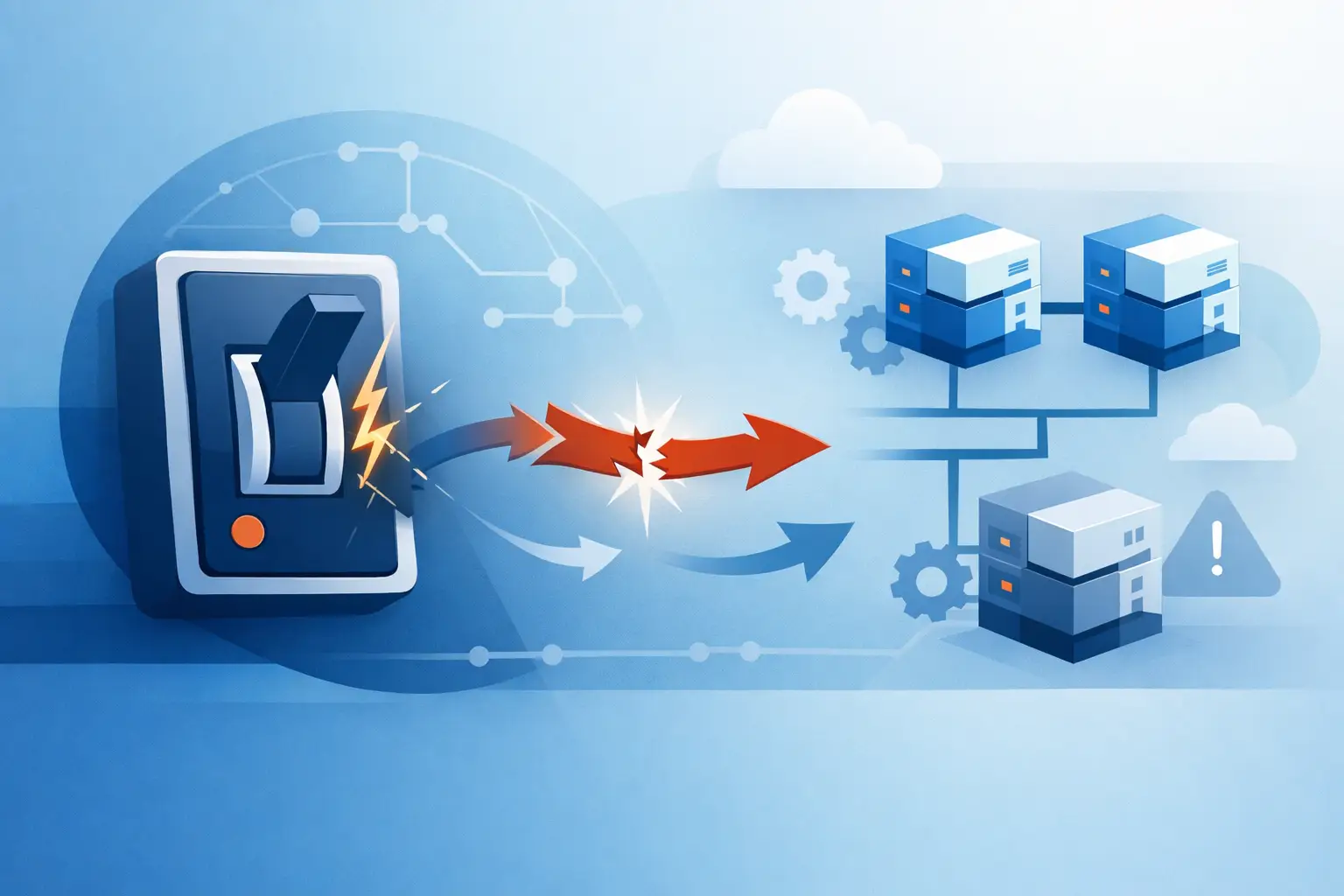
A checkout request can fail for reasons that have nothing to do with checkout code. A slow payment gateway, exhausted database connection pool, or unavailable inventory API can hold threads open until a healthy service becomes overloaded too. The circuit breaker pattern microservices use is designed to stop that chain reaction before a localized dependency problem turns into a platform-wide outage.
This pattern is simple in concept but easy to misconfigure in production. A circuit breaker is not a generic error handler or a substitute for fixing an unreliable dependency. It is a control point that detects unhealthy calls, temporarily rejects more traffic, and periodically tests whether the dependency has recovered. Used with sensible timeouts, fallbacks, and observability, it gives distributed systems room to recover.
What Is the Circuit Breaker Pattern in Microservices?
A circuit breaker sits around a remote operation, such as an HTTP request, gRPC call, database query, or message broker interaction. It tracks the outcome of those operations and changes behavior when failures or latency cross a configured threshold.
The familiar electrical analogy is useful: when a circuit has a fault, the breaker opens to prevent continued damage. In software, an open breaker prevents a service from repeatedly making calls that are likely to fail or stall. Instead of waiting for the downstream timeout every time, the caller fails fast and uses an intentional response path.
The pattern usually has three states.


Closed: normal traffic flows
In the closed state, requests reach the dependency as usual. The breaker records relevant signals, often a failure rate, slow-call rate, or consecutive error count. A few failed calls do not necessarily mean the dependency is down, especially when errors can be caused by invalid requests or short-lived network issues.
Open: calls are rejected immediately
Once the configured threshold is exceeded, the breaker opens. New calls do not go to the failing dependency for a defined wait period. The application can return a cached response, a default value, a queued operation, or a clear error to the caller.
Failing fast protects resources that are often more valuable than the individual request: worker threads, connection pools, CPU, memory, and retry capacity. It also avoids making a struggling dependency work harder during its recovery window.
Half-open: recovery is tested carefully
After the wait period, the breaker enters a half-open state. It permits a limited number of test requests rather than restoring full traffic at once. If enough of those requests succeed, the breaker closes. If they fail, it reopens and waits again.
That limited probe is essential. Sending a sudden flood of traffic to a dependency that has just restarted can cause a second outage before it is fully warm or scaled.
Why Cascading Failures Spread So Quickly
Microservices make it easy to divide business capabilities, but they also create dependency chains. An order service may call pricing, inventory, payments, tax, notifications, and customer-profile services. One slow dependency can increase request duration across the chain.
Without a circuit breaker, callers continue sending requests and waiting for timeouts. Thread pools fill. Queues grow. Autoscaling may add instances, which can multiply traffic against the already failing dependency. Retries, intended to improve reliability, can become an amplification mechanism.
A circuit breaker changes this failure mode from uncontrolled waiting to deliberate degradation. The order service might accept the order and defer confirmation, display cached inventory availability, or return a message that payment verification is temporarily unavailable. The correct choice depends on the business operation and its consistency requirements.
Circuit Breaker Pattern Microservices Need Alongside It
A breaker works best as part of a resilience strategy, not as an isolated library feature. The surrounding controls determine whether it reduces pressure or merely hides a problem.
Start with strict, realistic timeouts
A circuit breaker cannot help much if every remote call waits 60 seconds before being counted as a failure. Set connection and request timeouts based on user expectations, downstream service behavior, and the remaining time budget for the overall request.
Timeouts should be shorter than the caller’s deadline. If an API gateway allows 10 seconds for a request, a downstream call should not consume all 10 seconds by itself. Reserve time for fallback logic, cleanup, and an understandable response.
Use retries selectively
Retries are appropriate for transient failures such as a dropped connection or a temporary 503 response. They are a poor default for every error. Retrying invalid input, authorization failures, or a consistently overloaded service wastes capacity.
When retries are justified, limit attempts, use exponential backoff with jitter, and place the retry policy carefully. Retrying at several layers of the same call chain can turn one client request into dozens of downstream calls. In many cases, retry before the circuit breaker records the final failed operation, but the exact ordering depends on whether the team wants the breaker to react to individual attempts or exhausted retry cycles.
Isolate resources with bulkheads
Bulkheads prevent one dependency from consuming all available execution resources. For example, calls to a reporting service can use a separate concurrency pool from calls to payment processing. If reporting becomes slow, it cannot starve payment requests.
Circuit breakers reduce calls to unhealthy dependencies; bulkheads limit the damage while failures are still being detected. Together, they provide stronger protection than either pattern alone.
Design fallbacks as product behavior
A fallback should be useful, truthful, and safe. Returning stale product recommendations may be acceptable. Returning stale account balances, pricing, or permission data may create security or financial risk.
For write operations, a fallback may mean placing work on a durable queue for later processing rather than pretending it succeeded. If the system cannot guarantee the outcome, communicate that clearly. Silent data loss is not graceful degradation.
Choosing Thresholds That Match Real Traffic
There is no universal configuration for failure thresholds or open durations. A high-volume service can make decisions from a rolling window of hundreds of requests. A low-volume administrative endpoint may need a smaller count-based window or a longer observation period.
A practical initial policy might open a breaker when at least 20 calls have occurred in a 30-second window and more than half have failed or exceeded a slow-call threshold. The open state might last 15 to 30 seconds, followed by a small number of half-open probes. These are starting points, not production truths.
Tune the policy using real dependency behavior. If a payment provider has occasional five-second spikes but remains available, opening after a handful of slow calls may create more failed checkouts than it prevents. If an internal service tends to fail hard during deployments, a faster threshold may protect the rest of the system.
Also decide what counts as a failure. Network errors and timeouts commonly qualify. HTTP 429 and 503 responses may qualify depending on the contract. HTTP 400 responses usually should not, because they indicate a caller problem rather than an unhealthy dependency. Authentication failures should trigger security investigation, not necessarily a circuit state change.
Implementation Boundaries Matter
Place a circuit breaker at each remote dependency boundary, not around an entire business workflow. A checkout service that calls inventory and payments should have independent breakers for each. Otherwise, a temporary inventory issue could incorrectly block payments that are still healthy.
Name breakers clearly by dependency and operation, such as `inventory-reserve` or `payment-authorize`. Per-operation metrics make incidents easier to diagnose and prevent a high-error endpoint from affecting unrelated calls to the same service.
Popular application stacks provide circuit-breaker support through libraries and service frameworks, while service meshes and API gateways can enforce some traffic policies at the infrastructure layer. Application-level breakers are usually better for business-aware fallbacks because the code knows whether cached data, queuing, or a partial response is safe. Infrastructure controls are valuable for consistent network-level protections. Many mature platforms use both, with carefully defined responsibilities.
Observability Turns a Breaker Into an Operational Tool
An open circuit breaker is a symptom, not a success metric. Alerting only on open breakers tells operators that protection has activated, but it does not explain why the dependency degraded.
Track state transitions, rejected-call counts, failure and slow-call rates, fallback usage, timeout rates, and latency percentiles. Correlate these signals with dependency dashboards, deployments, infrastructure saturation, and changes in request volume. Logs should include the breaker name and outcome without exposing sensitive request data.
Test the behavior before an incident. In integration or chaos tests, inject latency, connection failures, and partial dependency outages. Verify that the breaker opens when expected, fallbacks are safe, half-open probes are limited, and recovery does not create a traffic surge. A resilience policy that exists only in configuration has not yet proved its value.
Common Mistakes to Avoid
The most common error is treating every exception as evidence that a dependency is unhealthy. This can open breakers because of bad requests or application bugs. Another is using a generic fallback that returns empty data, masking a serious operational problem from users and support teams.
Teams also underestimate the interaction between client timeouts, load balancers, retries, and breaker windows. A breaker may appear ineffective when its timeout is longer than an upstream gateway timeout, because users leave before the application can apply its fallback. Model the full request path, including asynchronous workers and scheduled jobs.
Finally, avoid leaving default settings untouched. Defaults are useful for experimentation, but production traffic patterns, service-level objectives, and business risk should shape the final policy.
A well-designed circuit breaker gives services permission to fail in a controlled way. Start with the dependency that has caused the most expensive latency or outage, define a safe response for its failure, and use production signals to refine the policy. That focused approach turns resilience from an architecture diagram into behavior your users can actually rely on.